
The Genesis of the Battle of Kurukshetra
[This analysis is based on the summary of the Mahābhārata story presented on this website as Gita Post #1 and Gita Post #2. The sentences are quoted directly from the two posts.]
Having understood the dharma of a Kshatriya, let us read again the following few sentences picked from the Mahābhārata story we have already read:
- He (King Śantanu) lived a life of absolute carnal pleasure, …
[No respect for Kshatriya Dharma; total absence of vishaya virakti (detachment from sense pleasures)]
- Inside him (Śantanu), dissension was brewing gradually, but he struggled to hide it for the fear of losing Ganga, who was to him the abode of pleasure.
[No respect for Kshatriya Dharma]
- Śantanu, the king of kings, was now old when the concomitant infirmities began showing themselves on his body. His hankering for sensual pleasures remained unbridled. He fell in love with a gorgeous young woman, Satyavati, the spellbinding fragrance of whose body not only announced her presence but also allured even an indifferent passerby.
[The old Śantanu should have installed his son Devavrata (before he became Bhīshma) as the king and left for the forests to pursue vānaprastha and sannyāsa (life of renunciation), according to dharma and the tradition prevailed.]
- The intelligent prince (Devavrata) found out the cause of his father’s gloomy disposition, rode over to the chief of fishermen, and made two vows: one, that he would never claim the throne of Hastinapura, and two, that he would remain all his life a celibate so that he would have no progeny to claim the throne either.
[As the crown prince, Devavrata’s dharma was to ensure continuity to the wellbeing of the praja (citizens), not pandering to the kāma (desires) of his aging father to whom it was time for vānaprastha and sannyāsa (life of renunciation). And the prince did not either have any right to offer the throne of Hastinapura to any unborn children of Satyavati.]
- Having learned about the svayamvara ceremony of the three princesses (Amba, Ambika and Ambālika) of a neighboring kingdom, Bhīshma went there and took away the princesses by brute force, in front of all the other princes and kings present at the ceremony.
[If he did it for him to marry them, it would have been in line with the dharma of a prince (according to smṛti), for his act would prove that he was braver and better qualified than all the others assembled in the swayamvara hall; the princesses would therefore be happy to accept the bravest among the kings and princesses.]
- One day, in the salubrious, stimulating ambience and the charming lone presence of his gorgeous wife Mādri, Pāṇḍu lost himself in the luring depths of conjugal love and never returned.
[Pāṇḍu knew it was forbidden for him (even for health reasons). If he was a strict adherent to Kshatriya Dharma, ensuring the continuance of his kingdom’s welfare would have been on top of his consciousness.]
- Yudhishṭhira never was a great winner of the game. In contrast, Uncle Śakuni was so dexterous in the game of dice that he could defeat anybody with his trickery and cheating techniques. He promised to play on behalf of Duryodhana and seal victory for themselves.
[The epic has unambiguous statements at several places that the game of dice is against dharma, against that of a Kshatriya (a member of the ruling class) in particular. The game was to be between the two Kings ̶ Duryodhana and Yudhishthira. When Śakuni decided to play on behalf of Duryodhana, Yudhishṭhira did not raise an objection. Further, knowing there was premeditated cheating involved, a not-so-skilled dice game player, Yudhishthira, did not have the diplomacy to avoid the game at the second invitation either. At that moment, the Pāṇḍava King was guilty of gross neglect of Kshatriya Dharma because the welfare of his Kingdom and that of his prajā (citizens) were his primary responsibilities.]
It is an undeniable fact that all the generations of the Kuru family, since King Śantanu had strayed far from the Kshatriya Dharma, followed by their ancient ancestors. Kings, since the time of Śantanu, were so caught in the allure of sensual pleasures and material gains that there arose within the royal family the inevitable strife between the two interest groups. The insatiable desire to seize the sovereign authority of the undivided Kingdom had to culminate in a battle.
We have more sentences quoted from the story, but with an added dimension ̶ vengeance!
- Burning with the desire to wreak vengeance, Amba did penance and propitiated the god Śiva who blessed her that in her next birth, she would become the reason for Bhīshma’s death.
[Do we not hear the echoes of a war cry?]
- The Sage (Vyāsa ) with his mystic powers foresaw the untoward consequences if he were to approach the princesses at once. He asked his mother to wait for a year to allow the princesses to mellow down and gain the right level of maturity in thinking. Satyavati rejected outright her son’s suggestion.
Observing the implacable princesses and their behavior and attitude, Vyāsa had predicted that Ambika would have a blind son and Ambālika a son afflicted by a life-threatening type of anemia. They were the fruits of their unrelenting desire for revenge.
[We observe here the brilliant scientific insight of Vyāsa. Parents of such unhealthy mental states will not have children of healthy bodies and minds. We should be able to relate to the tremendous increase in children born with too many congenital disorders in recent times. Here, it was significant that the princesses bore the sought-after descendants to avoid the extinction of a prominent dynasty of the time. Satyavati did not listen to Vyāsa since she could not gauge the magnitude of the peril he forewarned.]
- Although Dhṛtarāshṭra was the eldest, the law of the time prohibited a blind prince from ascending the throne. The lone choice was Pāṇḍu because Vidura, who was born of a handmaid, could neither qualify to be the king.
[The choice of Pāṇḍu as the King of Hastinapura marked the onset of the future war in the mind of Dhṛtarāshṭra, who was blinded by his unfulfilled kāma (desire to become the King); it is more important to note that there was a perfect candidate, Vidura, with all the inherent qualities to perform as a righteous king in accord with Kshatriya Dharma. The spirit of the original class definitions was already lost along with the loss of wisdom; otherwise, personal qualities and natural suitability for a vocation were the original criteria to be a member of a particular class. Here, Vidura, born of a handmaid, was denied the status of a Kshatriya based on his parentage!]
- When Duryodhana was born, nature became replete with terrible omens. The learned men like Vidura and other pundits were of the view that if Dhṛtarāshṭra sacrificed this child, he would save the world from grave peril. Dhṛtarāshṭra was so fond of his son that he paid no heed to the words of the wise.
[The vengeful, blind Dhṛtarāshṭra needed a ‘capable’ son to fulfill his secret dream!]
- Out of genuine affection for the Pāṇḍavas, Vidura spoke to Yudhishṭhira in absolute secrecy that Duryodhana planned to endanger their lives. The palace at Vāraṇāvata was made of special flammable materials such as wax and fiber, but finished with meticulous perfection to look safe and sound. Once the Pāṇḍavas settled in the palace, one of Duryodhana’s agents would set the wax-palace on fire. Having understood the enormity of the crime being conspired, Bhīma boiled inside and regretted that he could not give Duryodhana a fitting reply.
[The Pāṇḍavas became convinced that Duryodhana’s sole aim was to eradicate them along with their mother Kuntī ̶ a moment when the moral outrage of the Pāṇḍavas metamorphosed into a bloody encounter in waiting at any opportune time.]
- Many aspirants struggled to contain their jealousy when Karna picked up the bow and strung it with ease. Hardly had he aimed at the target when he heard a piercing voice asking him to stop; Draupadi proclaimed she would not marry a charioteer’s son.
[It was only a matter of time for the deeply wounded Karna to take reprisals.]
- The architecture of the palace was so deceiving to the senses that Duryodhana and the other Kauravas met with silly accidents everywhere in and around the palace. Draupadi, the queen of Indraprastha, could not hide her amusement at the follies of Duryodhana and his brothers, who trembled with rage as they left for Hastinapura.
[Witnessing the opulence of Indraprastha, Duryodhana was already in a fit of jealousy; this incident added fuel to the fire.]
- Following Duryodhana’s order, his brother Duśśahsana dragged Draupadi into the large dice game hall, insulted and attempted to disrobe her before the entire spectators including all the Kuru elders such as Bhīshma, Droṇā, et al. Bhīshma had an image in the Kuru family and even among the citizens that he was an authority on dharma. The urge to restore dharma at those moments of absolute depravity did not occur to the old Kuru hero either. Bhīma, the mighty Pāṇḍava, helpless at the moment for the fear of breaching dharma, vowed that one day he would kill Duśśahsana in a battle and drink his blood.
[War was virtually declared!]
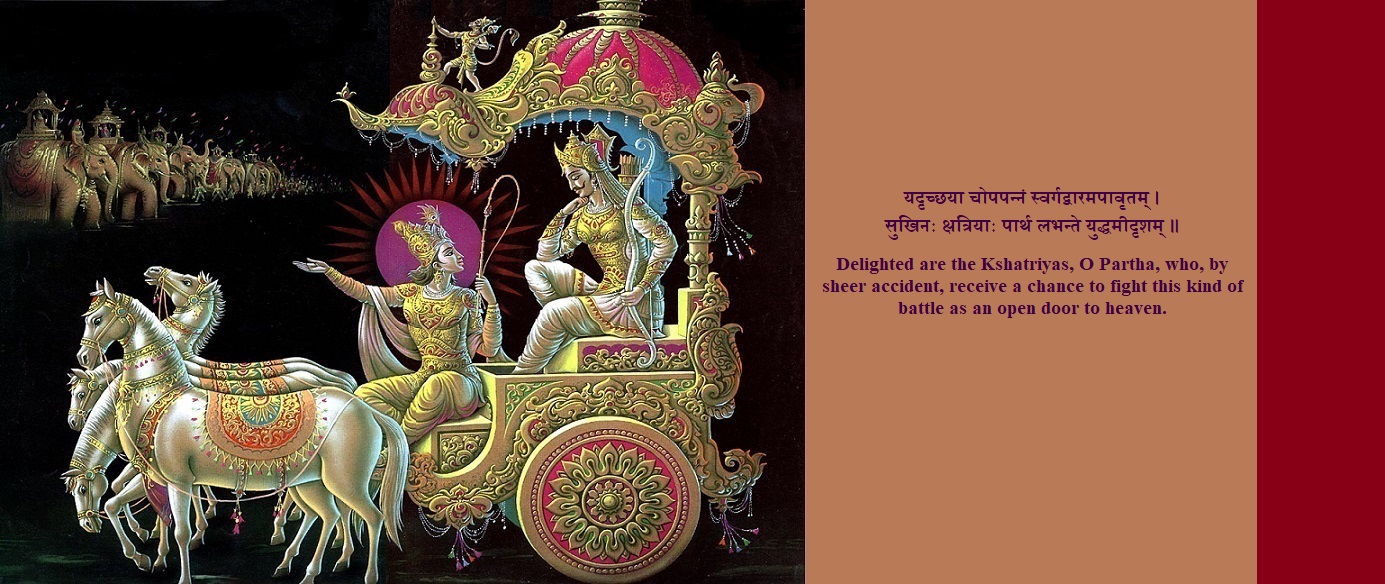
This discussion establishes the fact that the battle of Kurukshetra was not an event came about as a total surprise. Never an accident. Rather, it was the natural culmination of all the preceding happenings narrated in the epic. This is an extremely important point to remember when we study the Bhagavad Gita, for it will help us interpret a thoroughly misunderstood but crucial verse (verse 32, Chapter 2) that decides the way we understand what Kṛshṇa implies when he says, ‘join the fight’!
-------------------------
Leave a comment