
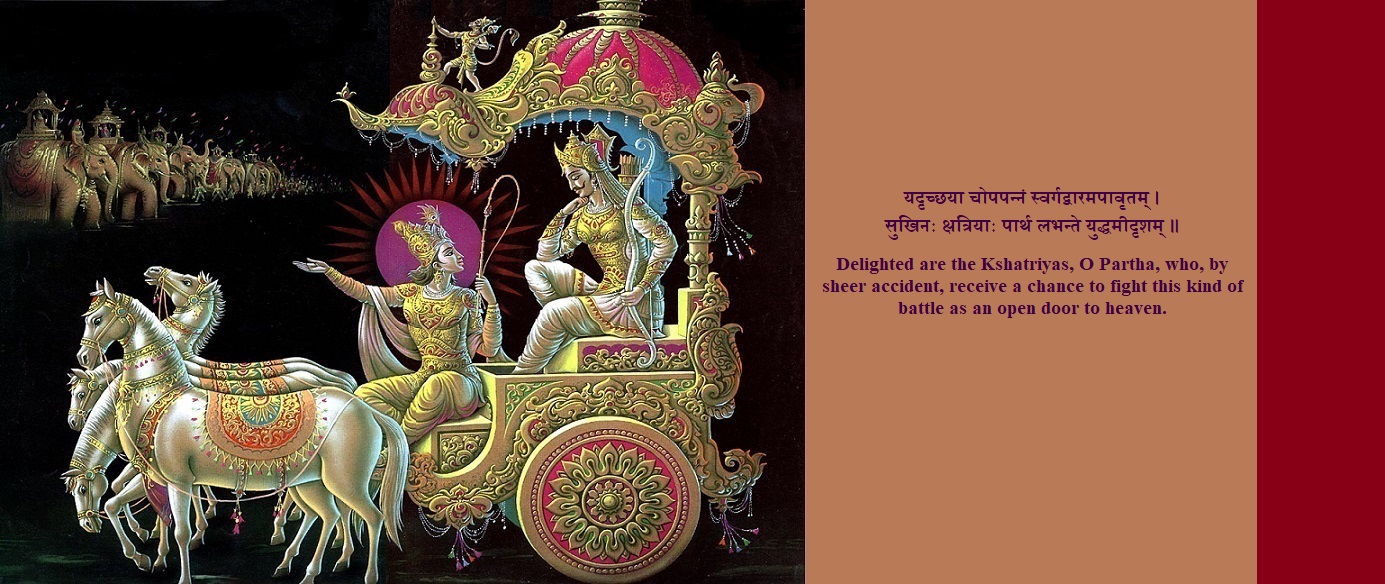
The Battle Krishna asks a Kshatriya to Fight
Why is it so important for us, the Gita learners, to have this paradox (about the battle Kṛshṇa mentions) resolved?
Swami Ranganāthānanda, in his book Universal Message of the Bhagavad Gita, makes a pertinent comment: “… in Australia, America and Europe, people ask me a question: ‘Arjuna seems to be better than Śrī Kṛṣṇa. He wants to have peace, he does not want war. Śrī Kṛṣṇa is egging him on to war. How can we accept this situation?’ ” (Universal Message of the Bhagavad Gita, Page 85, First Edition, by Advaita Ashrama, Kolkatta).
The Swami gives a long answer like many Gita commentators who face this question. We have deep respect for all those teachers whose expositions have taught us even how to read the Gita. One cannot fully refute their answer either, for we never know whether Sage Vyāsa intended more than one answer to this riddle.
But a deeper study is crucial because
(a) The students of the sublime philosophy of Vedanta have never been satisfied with this answer and the commentators do agree that their question is valid.
(b) If we believe Kṛshṇa calls this bloody war one of dharma and instigates Arjuna to fight the battle, then nobody defines clearly what a war of dharma is in the realm of the Upanishadic wisdom. Smṛti may have it mentioned, but Upanishadic teachings (content of the Gita as well) form the finality in wisdom, so they transcend the written codes in smṛti; in the wisdom context, nobody specifies on what circumstances such a disastrous war is permissible. It is not possible only because war is not dharma. For human beings, avoidance of war and violence is dharma (righteousness).
Let us note what Bhagavān teaches in Chapter 11 of the Bhagavad Gita: Brahman has an aspect by name Time (Kāla). The destruction seen in the Mahābhārata war is carried out by Time. It means, if the activities (karma) of human beings are not congruent with dharma, they culminate eventually in unstoppable destructive events over time as the natural consequences. It again emphasizes that the observance of dharma in its right sense will pre-empt the occurrence of wars.
The Mahābhārata war was indeed unstoppable because the thought of war had occurred long before in the minds of the parties involved; and the neglect of dharma at every stage in the epic compounded the situations which went out of control, so the war could not be stopped. That is the story of every war in history. But what does not occur to us is that wars can be avoided by a certain definitive way of life and managing the affairs of the world; and that is indeed the message of Kṛshṇa. He teaches in the Gita how to lead a perfect human life and to manage the affairs of the world with perfection. He does not ask Arjuna to wage the war and kill millions; in the Gita, Śrī Kṛshṇa does not say the Kauravas are Arjuna's enemies; instead, he takes pains to explain thoroughly in Chapter 3 and drives home the fact that the actual enemy of every human being is kāma (the desire for material gains). Kṛshṇa still knows that this war will take place, because it is already too late, as we have just pointed out.
-------------------------

Leave a comment