
Svādhyāya (Self-Study): Where do We Begin?
The fundamental texts that teach the vedantic wisdom are three-fold: The Upanishads-the ten principal ones although many more we have in number, the Brahma Sūtra and the Bhagavad Gita. Then we find many commentaries on the texts and a collection of independent treatises written in later times.
The ancient vedantic texts became less intelligible to later generations, as the context of those texts became less obvious. For humans often neglect the pursuit of Brahma-Vidya and lose the knowledge of Vedanta. It was the 8th century BCE philosopher-saint, Śaṅkarāchārya, who wrote brilliant commentaries on the basic Vedantic texts and made them accessible to serious seekers. He became successful in establishing his advaita darśana (the non-dual philosophy) through those commentaries. Although, in later times, several other philosophers and scholars challenged Śaṅkara’s advaita darśana, it continues, even today, as the most popular and universally accepted interpretation of the core Vedantic literature.
So, we follow Advaita Vedanta as the basis of our study. The other good reason to follow this line is that we have further revaluations and restatements of the Advaita Vedanta by wisdom teachers of modern times. The advaita (non-dual) teaching has thus become more explainable to us, the people of modern scientific age.
We will begin, of course, with one of the fundamental texts to ensure the authenticity of what we learn. The Upanishads, as mentioned, are many. In addition, the teachings of different Upanishads appear to be inconsistent, although that is not the case in reality. Śaṅkara’s commentaries obviate those misunderstandings over the Upanishadic teachings. The Brahma Sūtra, as brilliantly interpreted by Śaṅkara, further eliminates the confusions over the interpretations of the Upanishads.
Of special advantage, particularly to the beginners, is that the Bhagavad Gita epitomizes the essence of the Upanishads; and it expounds the philosophy with enough practical hints. Illustrating the most significant philosophy of life, the Gita is the ever-shining soul of the Mahābhārata. The epic is a vast reservoir of wisdom teaching; further, it serves as the best source of knowledge that explains many cryptic-sounding Gita statements.
The Bhagavad Gita will thus be the most interesting place to begin our svādhyāya (self-study).
A Unique Feature of the Bhagavad Gita
Vedanta philosophy guides individual seekers of Liberation. The Upanishads declare that complete detachment from worldly values is the only way to free oneself from the sorrows and sufferings that appear inescapable. Restating the Upanishadic wisdom, the author of the Mahābhārata further demonstrates it to be the unique means to ensure the total well-being of a nation (or the world) as a whole. The poet sets the teaching of the philosophy of paramount importance in human life in a dramatic scene, the kind of which the world has never witnessed. More significant is that the teaching addresses a Kshatriya (represents a ruler) whose prime dharma (functional responsibility) is to ensure the comprehensive well-being of the world. The world is rescued when the ruler is reformed. The commentators miss this part of the philosophy taught by the Bhagavad Gita, set in the context of the epic. A ruler’s transformation as a knower of Brahman makes him a rājarshi (king-sage). Then the world is saved, for the people will follow him. Under the rule of such a head of state, the citizens will also be wise, for the ruler as a knower of Brahman has the yogic ability to influence the world.
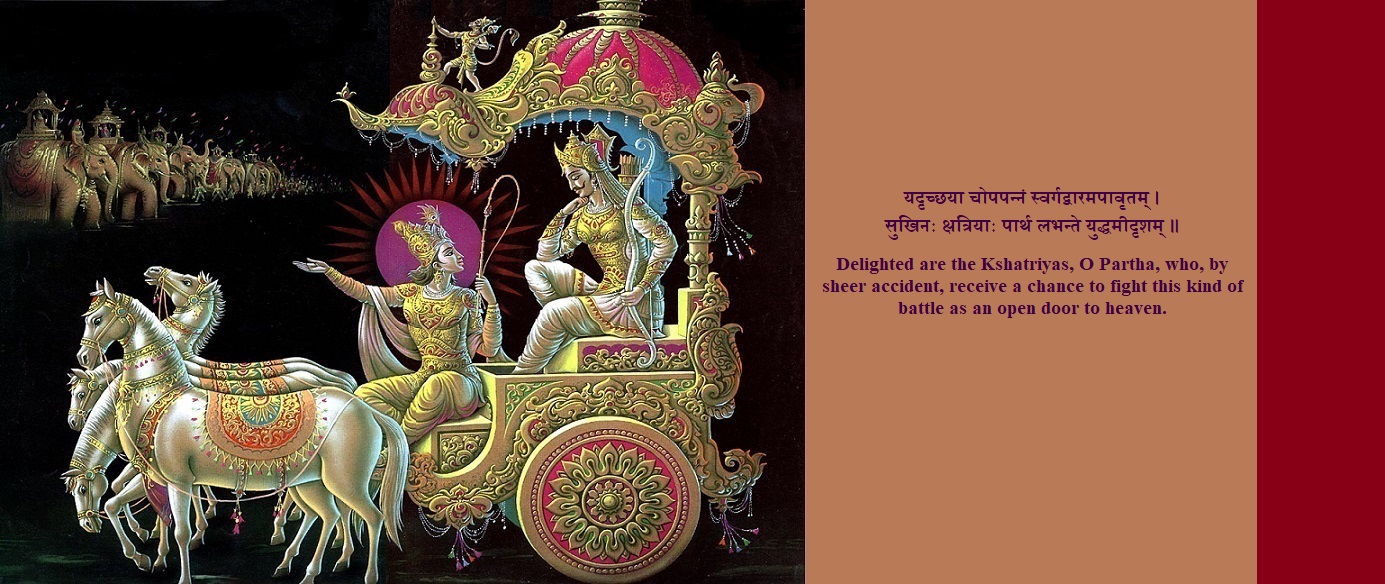
Vyāsa envisions the supreme well-being of the world as a whole (loka-samgraha) by instituting a governance system run by a class of enlightened rulers, rājarshis. They will perpetuate in the world the pursuit of yoga śastra, as taught by the Bhagavad Gita. Set in the context of the Mahābhārata, the Gita addresses at once both the well-being of the individual and that of the entire state. It is for that reason the poet chooses Arjuna, a Kshatriya (member of the ruling class) as the disciple. The Upanishadic philosophy restated in the Gita addresses the well-being of Arjuna, the individual. Raising the point of Arjuna’s dharma as a Kshatriya, Vyāsa simultaneously treats the matter of loka-samgraha, the well-being of the world. The latter aspect of the Gita teaching will not be obvious when commentators treat a Kshatriya as a mere warrior and his dharma as fighting battles.
So we will begin the Gita svādhyāya only after gaining a deeper understanding of (a) the context set by the author for wisdom teaching, and (b) what the true meanings of the terms Kshatriya and Kshatriya Dharma are. We need not have to search elsewhere for the right answers to our questions if we recognize the Mahābhārata a treasure house of knowledge, lacking in no detail related to the philosophy it teaches. Only if we make use of it, we will gain a fulfilling learning experience from our Gita svādhyāya.
Is there a relation between Vedanta and Yoga?
A question often asked is whether there is any connection between Vedanta and yoga. The Bhagavad Gita illustrates different facets of yoga and each time gives a definition too. Through a systematic process of defining yoga, the Gita finally defines it as the state of the seeker when he or she attains Self-realization or lives in oneness with Brahman.
A Vedantic analogy that explains yoga is one of ‘the space inside a pot’ (ghaṭākāśa). The space inside the pot and that outside are not different. If we break the pot, the space inside the pot merges (unites) with the open space. This is a perfect analogy to explain yoga. We believe that each one of us has a soul or a spirit within us. Vedanta calls it Ātman, which is the same as Brahman. In English, we use the word self or ‘individuated self’ to represent the soul or Ātman within each one of us. Compare it with the space within the pot. The same Ātman or Brahman pervades the entire universe at the same time. To represent it, we use the word Self, with a capital S. Compare the Self with the entire space outside the pot. But we have no direct knowledge or experience of our soul, the self. The Vedantin says that a thick veil hides the individuated self ̶ the veil of ignorance. Similar to the breaking of the pot, when a person is able to destroy the veil of ignorance, the individuated self (the soul) unites with the universal Self. The word yoga means union ̶ the union of the individuated self with the Self (Brahman). One who lives thus in union with Brahman is a yogi.
The Bhagavad Gita declares itself as (a) the essence of the Upanishads, (b) Brahma-vidya (the Science of Brahman or the Absolute), and (c) Yoga Śastra (the Science of Yoga). We see the Gita developing the concept of yoga step by step and explaining in the following sequence:
Chapter II: Explains the basic philosophical principle of yoga.
Chapter III: Teaches how to perceive the principle of yoga as Karma Yoga.
Chapter IV: Teaches how to perceive the principle of yoga as Jñāna Yoga.
Chapter V: Demonstrates how Karma Yoga and Jñāna Yoga merge into one, that is, yoga is only one.
Chapter VI: The Gita arrives here at its final definition of yoga in verses 20 through 23 read together. Verse 23 has the final part of the definition of yoga: Yoga is the complete liberation from the context of suffering.
Narayana Guru, the twentieth-century philosopher-saint who carried out the latest revaluation of Advaita Vedanta, has a poetic definition of yoga in his Vedantic work, Darśanamāla: “When mind, the bumble bee, sips the honey-like sweetness of one’s own bliss, fluttering ceases and is drawn into union.” [Translated by Guru Nitya Chaitanya Yati]
[The readers may note that the yoga we discuss here is not the exercise packages now sold worldwide.]
[ To visit the Bhagavad Gita Self-Study page, click/tap on this link: Bhagavad Gita Svādhyāya]
Leave a comment