

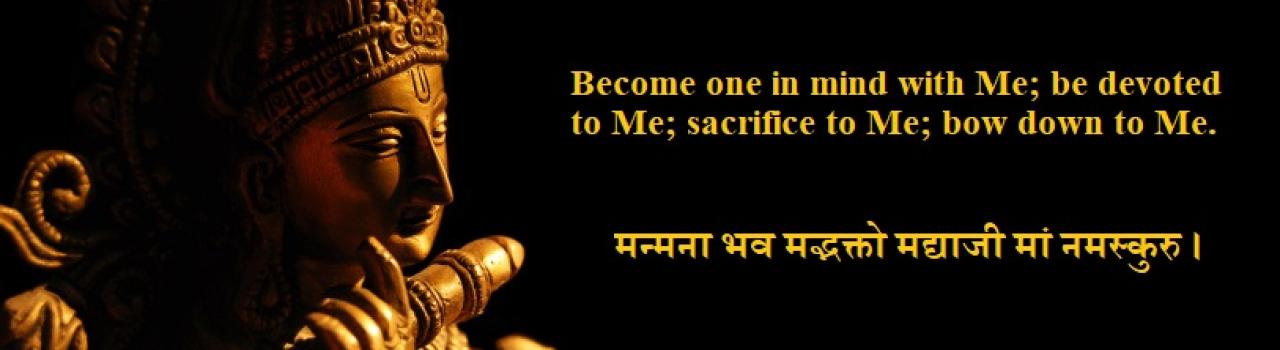
Understanding Krishna
Background
Kṛshṇa was not a character invented by Vyāsa. The name appears in the Vedas, the earliest compositions human civilization had produced. Indian scriptures, particularly the Itihāsas (epics) and the Puranas, have a style of employing gods and demons to represent the different aspects of the human mind. We saw elsewhere how beneficial that style was to describe the indescribable Reality. Ādi Nārāyana is the anthropomorphic form of Brahman itself. The Itihāsas and the Puranas are also wisdom-teaching scriptures, but as stories of avatars, many of them being the avatars of Nārāyana. Kṛshṇa is the incarnation of Nārāyana in the Mahābhārata. The name Kṛshṇa is very popular in India, so it is often used interchangeably with Nārāyana.
Sri Rama and Sri Kṛshṇa, incarnations of Nārāyana, have been integral to the culture of India from time immemorial. There are reasons to think that they were also historical figures of Indian mystic tradition of the times of unrecorded history. Since the ancient days, until today, there have been places preserved in India related to their birth and life. Those places can be well correlated with the descriptions in the Itihāsas (epics). Then, are the Itihāsas recorded histories of Rama and Kṛshṇa? Not so because, by definition, an Itihāsa (an Indian epic) is a composition distinct and different from pure historical accounts. Here is the definition:
The definition says an Itihāsa is a composition in a traditional scriptural form that incorporates a thoroughgoing treatment of dharma, artha (the profits of karma), kāma (desire for worldly/material values) and moksha (final liberation), all by adopting historical elements embellished to develop a full-blown fiction.
That explains the connection between historical figures and the epic characters.
Kṛshṇa of the Bhagavad Gita
The genius of the author of the Mahābhārata conceived in Kṛshṇa a model, which epitomizes Brahman (the Absolute) and appears on earth in the human form. He thus provides the ordinary human beings with a starting point to develop the awareness of Brahman. The formless Brahman is a hard notion for common people to conceive, for It is not perceivable by the human sense organs. They needed to be taught that the formless Brahman alone was the true nature of every being. Krishna teaches the same in the Bhagavad Gita.
Through Kṛshṇa, Vyāsa teaches the world the Science of the Absolute (Brahma-vidya). It is the all-encompassing wisdom, the source of which for the Gita is Vyāsa’s own wisdom or jñāna; so we can say Kṛshṇa represents Vyāsa’s wisdom or jñāna. Jñāna at once consists of (a) the doctrine of the transcendental Absolute and (b) the world (universe), the manifestation of the Absolute—the cause and the effect together. The thought leads us to the notion that Kṛshṇa is Brahman, the universe, the guru, and an ideal human being at the same time. We have Brahman in us too—our true nature. But Kṛshṇa is characterized as an incarnation of Brahman, who has always been aware of his omnipotence and omniscience. Vyāsa portrays the incarnation to play the ideal human being, the perfect model for all others to emulate, except that, occasionally, he makes Kṛshṇa reveal his true power.
Kṛshṇa tells Arjuna on a later occasion that he was yoga-yukta (in the perfect yogic state, as the Absolute) when he taught him the Bhagavad Gita. It also implies, at other times, Kṛshṇa was playing the human role! Therefore, for us, Kṛshṇa, who teaches the Gita, is none other than Brahman, the Absolute. We have discussed Kṛshṇa represents Vyāsa’s own wisdom (jñāna). We will further learn Brahman is jñāna itself, so we should contemplate and realize that Kṛshṇa and what he teaches in the Gita are the same Truth.
In the Gita, Kṛshṇa says he incarnates age after age to re-establish dharma when it suffers in the hands of the ignoramuses who run the world. How does he do it? He does not teach that dharma can be restored by killing all wicked men. [If he wanted, he could have wiped out at one stroke all the Kauravas by his yogic or Divine power. According to the Gita, the right method to restore dharma is different.] He incarnates to live by example and to teach humanity. We need not take this idea of incarnation in its literal sense; but one has the choice to consider, by correlation, that all the great souls such as the Buddha, Mahāvīra, Jesus Christ, Guru Nānāk, Sri Ramakrishna, Narayana Guru, Ramana Maharshi, et al. were the ‘agents’ of the Absolute! After all, the Absolute (Brahman) is the abode of total intelligence.
Kṛshṇa's life is the model. If the world takes the wisdom he teaches, dharma will prevail, or else the world will perish for sure, only to signify the advent of another age, and the cycles go on.
Bhagavān and the Bhagavad Gita
God is the widely understood meaning of the word Bhagavān, which is used to refer to Kṛshṇa in the Mahābhārata and therefore in the Gita too. Let us try to understand what the word signifies in Vedanta.
According to Vedanta, the worldly values and the incessant struggle of the human mind to accrue them lead to sorrows and suffering. A Sanskrit word that denotes such worldly life of suffering is bhava (भव). One can enjoy perfect, lasting peace only by overcoming bhava. Bhava, or life in the world involving such suffering, is compared to an ocean (sāgara). It is, therefore, bhava sāgara (भव सागर); to cross this ocean is a daunting challenge. The goal of human beings is to go across bhava sāgara to reach the region of Freedom ̶ become ever free from sorrows and suffering.
That which brings yoga (yogic state), ending bhava or worldly suffering, is bhagaḥ (in Sanskrit, it goes: bhavam nihatya yogam dadāti iti bhagaḥ). Bhagaḥ transports a person to the state of Yoga, in which sorrows and suffering disappear. Here we have the same bhagaḥ as a song (gīta), which is the Bhagavad Gīta. The guru who can provide the instructions that transport one to such yogic state is Bhagavān. In the Bhagavad Gita, therefore, Vyāsa makes it a point to specify that the words spoken by Kṛshṇa are the words of Bhagavān.
[ To visit the Bhagavad Gita Self-Study page, click/tap on this link: Bhagavad Gita Svādhyāya]
--------------

Comments (2)
Thank you so much for all the explanation and enlightening me with the meaning of Bhagvan. Keep doing the good work. Krishna is helping you spread the jnana.
Namaste!
Leave a comment