

The Bhagavad Gita, Chapter 1, Verse 1
[Gita Post #4]
The Bhagavad Gita
The Bhagavad Gita comprises eighteen chapters of the Mahābhārata section, Bhīshma Parva. The epic has one hundred thousand verses in eighteen parvas (sections) with two thousand chapters. In the Mahābhārata version published by the Gita Press, Gorakhpur, the eighteen chapters of the Bhagavad Gita appear as chapter 25 through 42 of Bhīshma Parva.
The Gita begins with a question asked by Dhritarāshṭra to his friend and advisor, Sañjaya. The King speaks only these few words of verse 1 in the entire Gita.
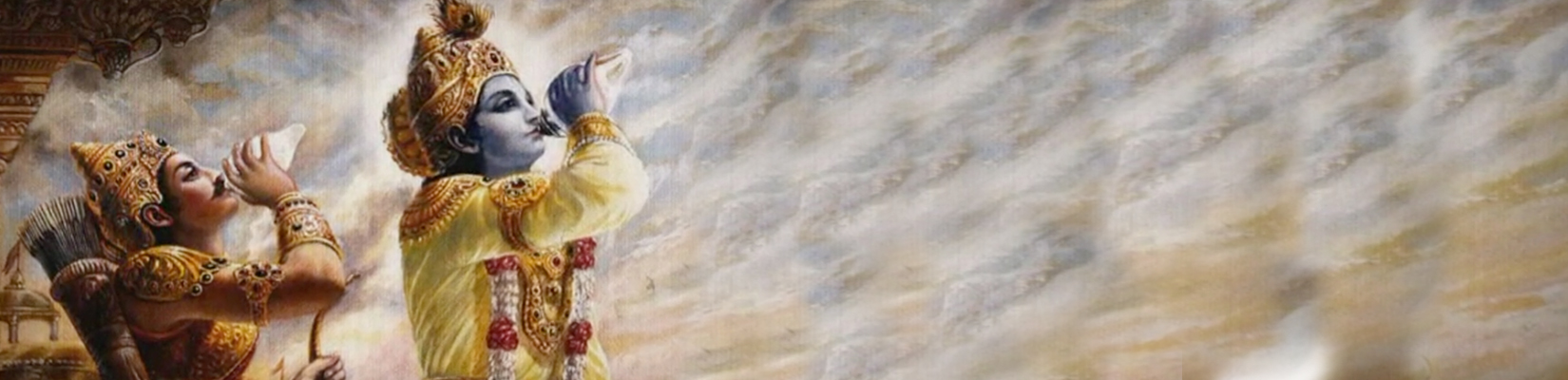
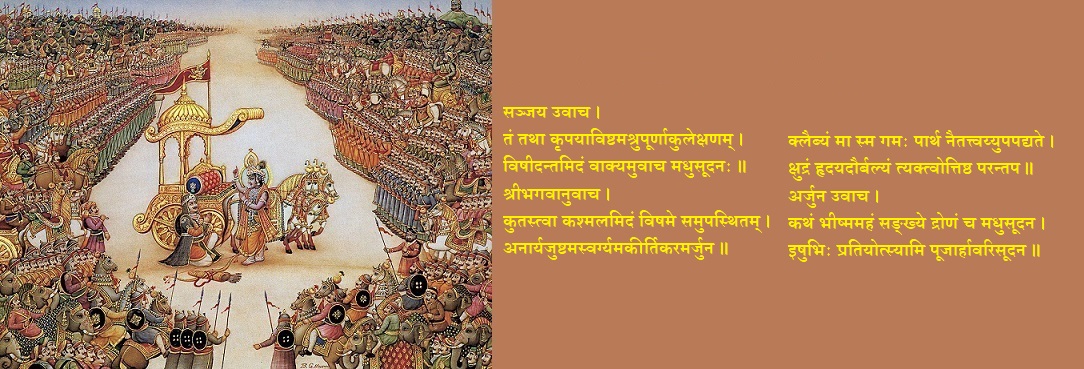
Let us find out at what point in the Mahābhārata Dhritarāshṭra asks this question. When the Kurukshetra war began, Sañjaya was present on the battlefield as a direct witness. He listened to the lessons in wisdom gave by Kṛshṇa to Arjuna, and watched the battle until the fall of Bhīshma, the Kuru patriarch, on the tenth day of the battle.
As Bhīshma fell, Sañjaya rushed back to Hastinapura, broached the news to Dhritarāshṭra and gave him a quick summary of what happened in the battle in the first ten days. Thoroughly shaken by the news of Bhīshma’s collapse, Dhritarāshṭra wailed. He was perhaps hopeful of his son Duryodhana’s victory, only as long as Bhīshma could stand up and fight. Then a long conversation took place between Sañjaya and the King, at the end of which Dhritarāshṭra asks again for a detailed description. That question is verse 1 of the Bhagavad Gita. Answering Dhritarāshṭra’s question, Sañjaya describes what he witnessed at the beginning of the battle; further, he reproduces verbatim the dialogue between Sri Kṛshṇa and Arjuna.
When the war was announced, Vyāsa offered the blind Dhritarāshṭra a divine vision to see the happenings on the battlefield. The King declined the offer, saying he had no strength to watch them directly. Vyāsa then gave the divine vision to Sañjaya because of which he could watch the battle from anywhere. Sañjaya thus had the choice to use the divine vision to do remote reporting of the battle. But the poet envisaged a better use for it. Without the divine vision, Sañjaya would have no access to a vital part of the knowledge imparted by Kṛshṇa to Arjuna ̶ Kṛshṇa’s display of the cosmic form of Brahman (Viśva-rūpa, Chapter 11 of the Gita). Thus, the divine vision Vyāsa gave Sañjaya enabled him to absorb everything Kṛshṇa taught Arjuna, and, back in Hastinapura, to reproduce every detail before Dhritarāshṭra. The story suggests the truth that wisdom (jñāna) was what Vyāsa offered to Dhritarāshṭra; but only one who is ‘fit and deserving’ can absorb it. The name Sañjaya means victorious in becoming pure ̶ pure by sublimating his vāsanas* and overcoming the frailties of his sense organs and mind. Those are the essential qualities of a seeker of wisdom.
[*Vāsanas: natural tendencies to go after the sensual needs of the body, etc.]
Peace Invocation
May Brahman (Aum) protect both of us together. May we enjoy together the attainment of wisdom. May we together gain the vital energy to attain wisdom. What we gain (Brahman) by this study may remain illumined. May we never become adversaries. Aum peace; peace; peace.
Let us chant this profound peace invocation as we begin our svādhyāya. It is the śānti pātha (peace invocation) of Katha Upanishad.
In the mantra we have just chanted, the ṛshi refers to two people ̶ the guru and the disciple. They are setting out on a spiritual journey. The mantra stresses the significance of the guru and the disciple being always together on the journey. It is a spiritual expedition undertaken for the sake of the disciple, for him to become a knower of Brahman (brahma-jñāni). The guru has to be a brahma-jñāni himself to lead the disciple on the right path. So, the mantra says the guru who guides a disciple is a jñāni committed to the spiritual awakening of the disciple. He only makes sure that the disciple is endowed with the right qualities to pursue the path to Brahman. Now they are chanting the mantra together in order to be protected together, etc. The guru, chanting together with the disciple, prepares him for their ‘togetherness’, which is a critical success factor in Self-realization. The guru, in the state of yoga, is living as Brahman. He is Brahman himself. All the same, unless the disciple can become the perfect counterpart in the togetherness, the goal is not achievable.
What is this togetherness? In popular Vedantic terms, it is the guru-śishya-pārasparya ̶ the pārasparya (bipolarity) between the guru and the disciple. The Sanskrit word paraspara means ‘each other’. Its noun form pārasparya literally means each-otherness. This each-otherness is a soul-to-soul connection between the guru and the disciple. Like a wireless link. That connection serves as a communication channel. Messaging through this channel involves no known factual language. We have heard the word muni, which stands for a sage or a true yogi who stays silent most of the time. Muni means one who stays in mauna (silence). The gurus who guide the disciples in their pursuit of Brahman are typically munis. The communication between the muni and the disciple takes place through their pārasparya, which, for simplicity, we called a communication channel. To successfully establish pārasparya with the Guru, the disciple should be one of śraddhā (absolute faith) in the guru’s instructions. (The concept of śraddhā we discussed elsewhere is an important one to remember. Click/tap on the link to read a description: Śraddhā.)
Śraddhā, when fully developed, the disciple will adore the guru as the abode of wisdom. Then, the unconditional grace and compassion (kṛpa) of the guru flows into the disciple. That is how the pārasparya (bipolarity) becomes established. The mantra further reminds that between the two there should never exist a rivalry, for it severs the pārasparya once established. The peace invocation addresses the all-controller, Brahman, whose grace (kṛpa) itself is the chance of realizing everything we pray for in the mantra.
We, the Gita learners, should begin with the same thoughts as in the mantra. May our learning experience lead us to where we want to be, by the grace (kṛpa) of the guru. The guru is Sri Krishna. Or, one could imagine the guru to be the Sage, Vyāsa. We have understood that, in their yogic state, the gurus exist as Brahman. Therefore, we have another free choice to place Brahman in our mind as the guru!
[The readers are free to choose any wise guru in whom they have absolute faith. To read the reason we have suggested one of the three options mentioned here, click/tap on the link Understanding Krishna.)
Aum peace; peace; peace: Through the three repeated invocation of the word peace, we are seeking the supreme peace that wisdom brings. Or, we seek to be free from the three kinds of suffering: ādhyatmika duḥkha (self-caused suffering), ādhibhautika duḥkha (suffering caused by the others) and ādhidaivika duḥkha (suffering because of natural causes, attributed to God).
The author has named every chapter of the Bhagavad Gita a Yoga. For every word Vyāsa uses, there is a reason. Chapter 1 does not teach any Yoga, yet it is called a Yoga. We hear different reasons from the Gita commentators to call it a Yoga. Śaṅkarāchārya, the great master on whose wisdom everyone depends, to study the Gita, did not write a commentary on this chapter. The Āchārya was perhaps keen only to interpret the very core philosophy of the Gita and left everything else for others to make out for themselves.
When we complete the study of this chapter, we would have found a compelling reason for the name Yoga for the chapter.
Dhritarāshṭra uvācha:
Translation
Dhṛtarāshṭra said: Hey Sañjaya, what did my people and the sons of Pāṇḍu do after assembling at Kurukshetra, the field of dharma (righteousness), prepared to fight the battle for the throne?
Annotation
Dharma—the Bhagavad Gita begins with this keyword. The first word or verse of a wisdom text, by tradition, will indicate the purpose and content the author has in mind.
We have seen elsewhere that Brahman, the non-dual Truth, is the one that presents Itself as the universe. There is a self-operating system that supports the universe and makes it work. Dharma is that system, which is integral to Brahman. The cosmic laws by which the universe operates too are part of dharma. In the world, we use the same word dharma to mean different things in different contexts. In order to distinguish dharma from other usages of the word, here we may call it absolute dharma. Because it is integral to Brahman, we say dharma is Brahman Itself. Vyāsa himself equates them both in the Mahābhārata. Using the word dharma at the very beginning is to declare that the subject of the Bhagavad Gita is Brahman. (We discussed dharma elsewhere. Click/tap on the link to read a description: Dharma.)
If we align our way of life with absolute dharma, we lead a righteous life or a perfect life. Only then will we enjoy perfect happiness, peace, and harmony. Our life otherwise is imperfect or one of adharma (opposite of dharma). A way of life not in harmony with absolute dharma causes worldly sufferings. A dedicated seeker who absorbs what the Gita teaches will know how to lead a life in conformance with absolute dharma. He/she is then on the path to the experiential knowledge of Brahman, or the path to liberation (mukti or moksha).
Dhritarāshṭra is knowledgeable, particularly in the domain of dharma. In the Mahābhārata, sometimes he speaks words of perfect dharma. But he nurtures a secret dream to be the unchallenged king forever. He is blind by birth. His undue aspiration makes his mind and intellect blind as well. The extreme affection for his sons eclipses his knowledge of dharma. These traits of Dhritarāshṭra are obvious from this verse when he discriminates in favor of his sons by saying, ‘my people and the sons of Pāṇḍu,’ even though the Pāṇḍavas treat their paternal uncle with love and respect.
Dhritarāshṭra's simple-sounding question employed as a prompt to start the Gita teaching should be saying something more. For a deeper understanding of this verse, please click/tap on the link and read: Swami Nirmalānanda Giri on The Gita Verse 1. It helps us gain a distinct perception of the usage of the words dharma-kshetra and kuru-kshetra. (There are many interpretations available for the words dharma-kshetra and kuru-kshetra. We leave the most common ones and choose an insightful way of explaining, which suits the philosophy of the Bhagavad Gita.)
---------------
(To read the next post [Gita Post #5] click/tap on this link: https://www.ekatma.org/node/182)

Leave a comment