
The Bhagavad Gita, Chapter 2, Verses 9 ... 13
Gita Post #16
[Arjuna ended his words saying: My vitiated mind, lacking the discriminating wisdom, is bewildered owing to my incompetence at dharma. So I would ask you to reveal that which is definitely of supreme merit (śreyaḥ) to me. I am your disciple. Instruct me who has taken refuge in you. Even if I am to gain the unchallenged, prosperous kingdom on earth or even the supremacy over the gods in heaven too, I see not that which relieves my distress that burns the senses.]
Translation
Sanjaya said: Having spoken thus to Hṛshīkeśa (Kṛshṇa), Guḍākeśa (Arjuna), the Terror of Enemies, said to Govinda (Kṛshṇa), “I will not fight” and remained silent—what a surprise!
Annotation
Arjuna is determined, “Without knowing that which is supremely meritorious (śreyaḥ) to me, I am not going to move.” The exclamation is about this resolve of Arjuna. It is rare to see such preparedness to seek wisdom on the spot, despite being in the middle of the two fighting armies.
Sañjaya uses two epithets of Arjuna to give hints to Dhṛtarāshṭra: He is Conqueror of Sleep (Guḍākeśa), so he will be back soon from his trance (kshudra samādhi). He is Terror of Enemies (Parantapa), so the sons of Dhṛtarāshṭra will have a terrible time when he stands up and fights.
Translation
O Bhārata (Dhritarāshṭra), to him who was sitting in distress, between the two armies, Hṛshīkeśa (Kṛshṇa), as though smiling, spoke these words.
Annotation
When Arjuna suffers from anguish, Kṛshṇa appears to be smiling! It must relieve Arjuna of his anxiety to a certain extent, because Kṛshṇa gives him the hope that his problem is solvable.
In addition, Bhagavān’s cool smile might also convey to Arjuna a message that he is being silly. He has never grieved like this. Let the problem be anything; is it expected of a gallant hero such as Arjuna to become disheartened so easily? In Virāṭa (while in exile), Arjuna was all alone to fight against Duryodhana and his army, which included Bhīshma and Droṇa. They accepted defeat before him and retreated. The battle against his family men and gurus is then not what holds Arjuna back. Kṛshṇa knows what the root cause of Arjuna’s vishāda (distress) is, so he educates him by referring to his apparent concern for all those who will die in the war.
Translation
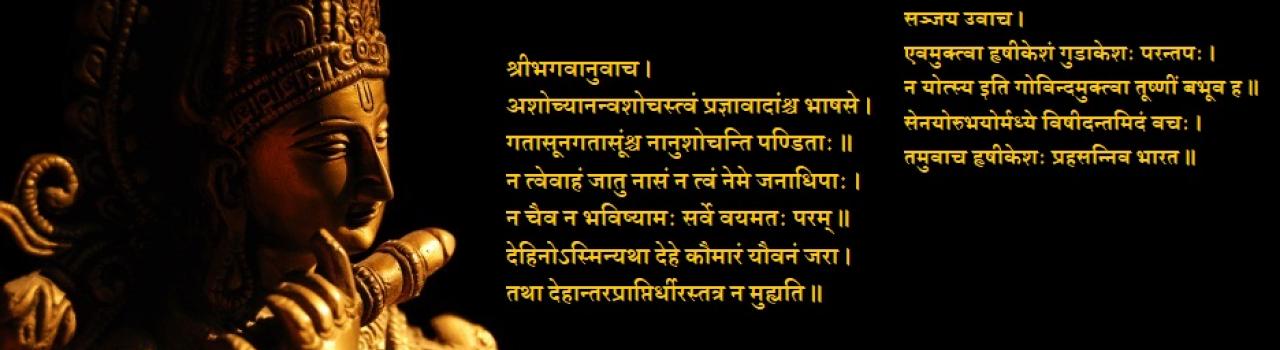
Śrī Bhagavān (Kṛshṇa) said: You grieve for those for whom no one should grieve, and yet you speak like the wise. The wise mourn neither for the dead nor for the living.
Annotation
[The Bhagavad Gita teaching begins with this verse. We should keep in mind that not every verse in the Gita is part of the Yoga Śastra it teaches. We have mentioned the style followed here is dialectical. Kṛshṇa himself cites many a time the views opposed to the philosophy and then asserts what the final siddhānta (established truth/doctrine) is. We should therefore discriminate between the pure teaching of Vedanta and the worldly norms and arguments Kṛshṇa quotes.]
Arjuna is knowledgeable about the relative world. To that extent, he may be a learned person.
“The wisdom (jñāna) of Brahman keeps one from grieving for the dead or the living”, Kṛshṇa begins by telling a secret to Arjuna. “Arjuna, you are speaking like a wise person and but wailing like an unwise.”
In this opening verse, Kṛshṇa gives the diagnosis of and the remedy for Arjuna’s problem: “You grieve for the people who are going to lose their lives because you have not known Truth, even though you speak the words of the wise. Paṇḍitaḥ (the wise) know Truth, so they never mourn for anyone. Thus, the solution for you is to become wise, a paṇḍita* or a jñānī. Become a knower of Truth.” Through the very first words of Bhagavān, the Gita declares that there is only one comprehensive solution for all the problems of the relative world ̶ know the ultimate Truth.
Here, Kṛshṇa’s words signify that he will teach Arjuna how to become a jñānī or what it takes to become a jñānī. Or, the subject matter of the Bhagavad Gita is Brahma-vidya, which enables a seeker to become a jñānī (knower of Truth or Brahman). While Kṛshṇa agrees to teach Arjuna, the words imply, although unsaid, that he alone has to decide what he should do thereafter; the decision depends solely on whether he imbibes the teaching in its totality. We hear Kṛshṇa the Guru’s quiet message: “I have no role in making you stand up and fight the battle.” There is an occasion (Chapter 3) when Arjuna asks why Kṛshṇa insists on him to fight, a question because he fails to understand what Bhagavān has implied. Kṛshṇa then continues and elaborates on Yoga Śastra, ignoring Arjuna’s reference to the battle. A wise guru teaches in good faith that the disciple will profit from the lessons, expecting nothing in return.
[*Paṇḍita: one who possesses paṇḍā (jñāna or wisdom).]
We should note that Arjuna and Kṛshṇa have a new relationship from this moment onwards. It lasts until the end of the Gita dialogue between them. Here, we witness the unfolding of a guru-disciple relationship. To Arjuna, Kṛshṇa is not a charioteer nor a friend for now, but Bhagavān.
[The reader is reminded of our definition of Bhagavān: the guru who can provide the instructions that transport one to the yogic state, in which sorrows and suffering disappear.]
Translation
I was never non-existent, nor were you and those kings on the battlefield. And in the future, all of us will not be non-existent either.
Annotation
In this verse, Kṛshṇa further amplifies the secret he has revealed in the previous verse. “Hey Arjuna, you asked me how you could kill Bhīshma, Droṇa and such others who are worthy of worship. Therefore, I must enlighten you about the Truth. Listen. The kings and soldiers standing on this battlefield were never non-existent. Do you understand what it means? We were never born, and would never die, so we have existed forever and will continue to exist. When that is the truth, how can you kill anybody? For that reason, I have said those who have known Truth will not grieve for the dead or the living. What you see as birth and death are far from Truth.”
Arjuna has presented all his arguments in favour of his decision to desist from the battle. Regarding Arjuna’s arguments, the author of Jñāneśvari imagines what Kṛshṇa’s thoughts would be at this moment:
“Arjuna, are you the cause of existence of this universe?”
“Will you not admit that the scheme of this universe exists from unknown ages?”
“Your attitude might imply that you are the author of life and death and you can recall or alter these factors at your will.”
Kṛshṇa, according to Jñāneshvari, sounds that Nature works in its own ways; Arjuna is ignorant and behaves as though he could control and change its course. He needs to be enlightened to understand how it works.
Arjuna may need more clarification. Kṛshṇa, the Absolute, has the answers to every question he has in mind.
Translation
As the embodied (dehī or Ātman) stays unaffected within the body during childhood, youth and old age, so does it remain unaffected while moving to a different body. The wise are not bewildered by this.
[Ātman present within, and animates, a living being is referred to as dehī (the embodied).]
Annotation
“Arjuna, when you say you have killed somebody, you have only mutilated the body, but the body is not the real person!” Kṛshṇa adds quickly, “Do not think I am asking you to harm or kill anybody. I am only trying to address your ignorance, which, a little earlier, you have called kārpaṇya dosha (कार्पण्य दोष) ̶ the inability to discriminate between Truth and non-Truth. So, now I explain to you what is Reality.
“Do you know that the body at every stage of life is as good as a different body? In fact, the changes in the body are continuous (old cells are replaced by new, hairs fall and new hairs grow, etc.), so the body at this moment is not the same as that at the next moment. Every time a change happens in the body, remember, the body is new. If you do not fully understand what I say, think whether a child’s body is the same as that when he or she becomes an adult—completely different. At old age, it is still different. I have only said that change is continuous, so every moment your body undergoes an unimaginable number of changes to become a new one.
“But Arjuna, you need to know we all have one thing common among us which stays unchanged forever. That common thing stays in all our bodies at the same time. Use your imagination to visualize the scenario. Let us call the common thing in all of us dehī (the embodied). As I have said, the body keeps changing all the time, but dehī (the embodied) stays within us unperturbed and unchanged. In effect, the embodied ‘lives’ in a new body every time a change occurs. It stays just as a witness to all that is happening in the body. Do you follow me?
“Now, when the present body becomes old, worn out and no more sustainable, dehī (the embodied) discards it and moves to yet another body. Doesn’t it make sense? Dehī always remains the same, but now in an entirely new body. The unwise call this process the death of one body and the birth of another. On one side, people cry and on the other, they rejoice. Now you tell me whether grieving over deaths or celebrating births makes sense. Who dies here or who is born? In reality, only one dehī keeps taking new bodies and discarding old ones. Since It stays in the multitude of bodies in the world at once, we think all the bodies have existence. No, true existence is only for the one dehī. Dehī is the same as Ātman or Brahman, but we call it with a new name because we refer to the Ātman staying within the body (deha). Dehī keeps switching bodies, but never born nor does it die.
“Let me be clear; only one thing has existence and It has never been non-existent. That is dehī or Ātman. But every living being is essentially this immutable dehī, not the perishable bodies. Dehī or Ātman is inside as well as everywhere outside, animating all living beings. It is for that reason I have said: 'I was never non-existent, nor were you and those kings on the battlefield. And in the future, all of us will not be non-existent either.' ”
[Arjuna has heard what has been told in the verse more like an aphorism. But Kṛshṇa, the Guru, wants the listeners to do manana (contemplation and meditation) and understand his words in a fashion similar to the foregoing and beyond. The learners of the Bhagavad Gita or of any Vedantic scripture can derive maximum benefit only by engaging in manana on the tattva (principle or doctrine) being taught.]
What Kṛshṇa explains to Arjuna about the change of bodies has nothing to do with re-birth. He is emphasizing a fact that the Ātman remains unaffected always. Our svarūpa (own true nature) is Ātman, not the fleeting body that keeps changing continuously. Even when this body is gone, the same Ātman stays in all the other living bodies and in the new bodies that emerge. The wise who know this truth have no fear of death. [The word dhīraḥ (धीरः) used in the verse means one who is firm in mind, but it also means the wise one (it even stands for chidātman, the jñāna or knowledge aspect of Ātman).]
The word muhyati (मुह्यति) in the verse is the verb form of the word mohaḥ (मोह:), which means perplexity, delusion, embarrassment, confusion, etc. In this context, it describes Arjuna’s state of mind when confused between the real and unreal, or when he has taken the unreal (the body, etc.) for the real.
Kṛshṇa has thus diagnosed Arjuna’s problem, and he is certain that the treatment for the moha which afflicted Arjuna is only the knowledge of Ātman or Brahman. If we can trace all our bewildering experiences, we will reach the same conclusion ̶ the study of Brahma-vidya will help remove all delusions and confusions in life.
While dehī stays unperturbed by the changes that take place in the body, what does deha (body) feel? We will listen to Bhagavān.
--------------------
(To read the next post [Gita Post #17], click/tap on this link: https://www.ekatma.org/node/196)


Leave a comment