
The Bhagavad Gita, Chapter 1, Verses 2 ... 7
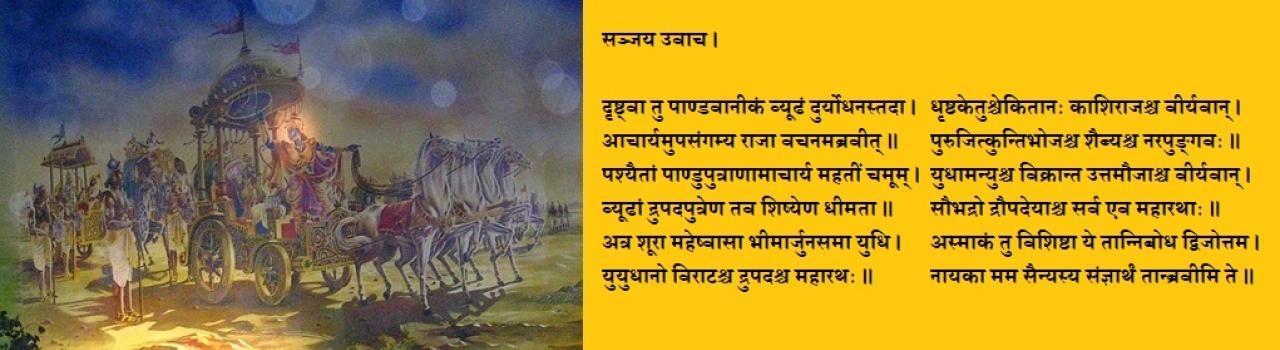
Sañjaya uvācha:
Translation
Sañjaya said: Seeing the army divisions of the Pāṇḍavas arranged skillfully in battle formations, King Duryodhana approached his master Drona and spoke these words.
Annotation
There are eighteen divisions (akshauhiṇis) of battle-ready armies on the two sides together; eleven are on Duryodhana’s side and the Pāṇḍavas have only seven. Of the soldiers in each division, 21870 are chariot-mounted, 21870 elephant-mounted, 65610 horse-mounted, and 109350 are foot-soldiers. The difference in the sizes of the two armies is conspicuous. Although the Pāṇḍava army is much smaller in comparison, Duryodhana mulls over the merits and demerits of the two armies.
When the battle is about to begin, Duryodhana makes some observations of his own. Then he wants to speak to his master, Drona, who is the teacher of the science of warfare for both the Kauravas and the Pāṇḍavas. On the battlefield, Drona is on Duryodhana’s side to fight for him. Bhīshma, the grand old patriarch of the Kuru family and Kṛpa, the family guru of the Kurus, are among the other prominent army leaders on the Kaurava side.
Duryodhana declared Bhīshma the Supreme Commander of the Kaurava army. Still, on the battlefield, he approaches Drona and speaks to him. Let us listen to his words.
Translation
O master, see this grand military force of the sons of Pāṇḍu, arranged in battle formations, with consummate skill and intelligence, by your disciple, the son of Drupada.
Annotation
As Duryodhana speaks to Drona, his very first comment is a telling evidence of his impression about the Pāṇḍava army. The son of Drupada (Dhṛshṭadyumna, the Supreme Commander of the Pāṇḍava army) has arranged the battle formations. He is intelligent and perfect in the science of war, Duryodhana acknowledges. He recognizes that the meticulous planning and arrangement makes the Pāṇḍava force formidable, although in size it is much smaller.
In the Mahābhārata story, we saw the vengeful King Drupada wanted an able son to kill his arch-rival, Drona; from the sacrificial fire, he got one, Dhṛshṭadyumna, whose life’s mission was to kill the acrhery master of the Kurus. Even after knowing that, Drona did not refuse to teach Dhṛshṭadyumna the science of warfare. Here we sense a subtle sign of Duryodhana’s exasperation, as though he wanted to say to Drona: You nurtured your own killer and trained him to become exceptionally skilled in war techniques; now, he turns out to be an enormous threat not only to you but to the entire Kaurava army.
Does Duryodhana sense how difficult would it be for his army to match that of the Pāṇḍavas?
We will read the next three verses together.
Translation
Here in the Pāṇḍava army, there are gallant mighty archer-warriors, who equal Bhīma and Arjuna in battle, such as Yuyudhāna (also known as Sātyaki), Virāta, and Drupada, the great-chariot-warrior;
Then, Dhṛshṭaketu (the son of Śiśupāla of Chedi Kingdom), Chekitāna and the heroic king of Kāsi, Purujit and Kuntibhoja and the noble among men, King Śaibya;
And the valiant Yudhāmanyu, the heroic Uttamaujas, the son of Subhadra (Abhimanyu) and the (five) sons of Draupadi. All are indeed great-chariot-warriors.
Annotation
In the earlier verse, we have heard Duryodhana sounding that the Pāṇḍava army had a virtually impregnable battle formation. The technical name of the formation arranged by Dhṛshṭadyumna is Vajra Vyūha.
Now he is naming the indomitable war leaders present in the Pāṇḍava army, although Drona is familiar with every one of them. The majority are the friendly kings and princess of different kingdoms who declared their support to the Pāṇḍavas; all came prepared with their armies to fight the battle, to help the Pāṇḍavas win the kingdom they lost. Purujit and Kuntibhoja are the brothers of Kunti. The five sons of Draupadi are Prativindhya, Śrutasoma, Śrutakirti, Śatānīka and Śrutasena.
Duryodhana has named seventeen elite warriors, each one of whom could equal either Bhīma or Arjuna. Having seen the unbeatable battle skills of Bhīma and Arjuna, he has always considered them his greatest threats in a battle. Now, he counted seventeen more heroes as intimidating as them, standing on the side of the Pāṇḍavas! Perplexed at the sight of so many equals of an Arjuna or a Bhīma, he misses mentioning the other three Pāṇḍavas ̶ Yudhishthira, Nakula and Sahadeva, who are equally skilled warriors too. With the five brothers added, the count becomes twenty-two.
Is there a reason for Duryodhana to be nervous?
Translation
For you to recognize them by name, I mention now, O best of the twice-born, the distinguished ones amongst us who are the leaders of my army; may I have your attention?
Annotation
Duryodhana addresses his master as best of the twice-born; twice-born refers to the Brāhmaṇa community to which Drona belongs. The author of the Gita has an obvious purpose in using the term. The specific dharma (functional role) of the Brāhmaṇas is to dedicate their lives to learning and teaching the Vedas and Brahma-vidya, living by it, and being a model to the world. Their natural function (svadharma) is to support the ruler in observing dharma in governance and to teach the rest of the world. The ruler then has the direct responsibility to take care of the well-being of the brāhmaṇas. This is to happen in the ideal situation. Vyāsa, therefore, reminds the world that dharmic values have disappeared. And he does so using the epithet twice-born (dvija) along with an added stress by saying best of the twice-born (dvijottama)! It is as good as asking, “What has a brāhmaṇa to do on the battlefield? Isn’t he supposed to do a far more honorable job?” In a subtle way, the poet asserts fighting battles is not the svadharma of Drona.
In the Mahābhārata, Vyāsa emphasizes in many places that non-killing (ahimsā) is the supreme dharma (ahimsā paramo dharma). But, on the battleground, ahimsā has no relevance. Therefore, if ahimsa is the ultimate dharma according to the Mahābhārata, the epic does not justify any war. When in the world dharma becomes weak, wars do take place. The story thus has in it a gruesome war, not to justify wars of any so-called noble purposes but only to teach a cardinal principle. The Sage teaches showing the terrible aftermath of the war that avoiding war is dharma; being free from all reasons for conflicts is dharma. We will find this underlying truth becoming more visible as we learn Brahma-vidya.
A brāhmaṇa is a teacher of dharma. His functional role by nature (svadharma) prohibits him from himsā (hurting or killing). Drona’s presence on the battlefield as an army commander is to show that dharma is now at its worst.
[Note: In ancient India, there was a system of functional grouping of people known as chātur-varṇya (four-fold color grades). The four functional groupings were the Brāhmaṇas, the Kshatriyas, the Vaiśyas and the Śūdras. When instituted, with noble intent, the system had nothing to do with the caste system that emerged in later times. We will discuss more when the Gita itself talks of chatur-varṇya.]
Having enumerated the distinguished leaders in the Pāṇḍava army, Duryodhana is going to name those in his own army. It may sound superfluous for him to ask Drona to recognize them by name when he knows every one of them already well. Still, Duryodhana wants his teacher’s attention to the names he is about to mention. Do we not sense he wants to convey something very important?
Let us listen to what he says in the next two verses.
-------------------
(To read the next post [Gita Post #6] click/tap on this link: https://www.ekatma.org/node/184)

Comments (2)
Your blog is interesting. Loooking forward to next Sunday post. Good luck.
Thank you. Namaste!
Leave a comment