
The Bhagavad Gita:The Soul of the Mahābhārata - Part II
[Gita Post #2]
Mahābhārata story - Part II
The Pāṇḍavas Marry Draupadi
The Pāṇḍavas and their mother wandered all over the woods, where nobody could recognize them. They suffered terrible hardships during those days. An encounter with a man-eating demon, Hiḍumba, was shocking. Bhīma killed the demon and married his sister Hiḍumbi, who fell in love with him. Ghaṭolkaja, a son, was born to the couple, whom Hiḍumbi promised to look after on her own, leaving Bhīma to continue the wandering life with his mother and brothers. On the way, they met Sage Vyāsa. The Sage knew what happened to Kunti and her sons, and what more would happen to them in the future. He asked them to disguise themselves as brāhmaṇas; then he arranged their stay with a brāhmaṇa family in a village named Ekachakra. Vyāsa consoled Kunti, saying that good things were yet to happen to her sons, and then left, promising to return after a month.
The Pāṇḍavas learned of a demon named Bakāsura who had held the people of Ekachakra to ransom. He demanded the villagers to give him a meal every day that should include a cart full of food along with the man who carried it; otherwise, he would eat them all together. The villagers complied with the demand to avoid any massacre by the demon. To the delight of the people of Ekachakra, Bhīma killed Bakāsura and freed them forever from their abject misery.
There in Ekachakra, the Pāṇḍavas heard about the svayamvara of the princess Draupadi, the daughter of King Drupada of Pānchāla. Vyāsa returned promptly after a month, when the Pāṇḍavas were preparing to leave for Pānchāla. The Sage narrated the story of Draupadi’s previous birth by which her destiny now was to have five brothers as her five husbands. He blessed the Pāṇḍavas who were about to set out to take part in the svayamvara.
[Svayamvara: A royal ceremony for a princess to marry usually the winner of a challenging contest that the king decides upon. The princess’s choice/decision was final.]
In King Drupada’s capital, Kunti and her sons, in the guise of brāhmaṇas, accommodated themselves in a potter’s place. On the svayamvara day, the five brothers left their mother at home and went to the palace of King Drupada. There were separate rows of seats in the svayamvara hall marked for different categories of invitees and non-invitees, such as princes and kings, brāhmaṇas, and others. The sons of Kunti sat among the other brāhmaṇas present there. Kings and princes of many, many distant kingdoms had arrived there, among whom included Duryodhana, his brothers, and his friend Karna. Kṛshṇa and his elder brother Balarāma were also present along with the other princes of the Yādava clan only to watch the ceremony, for Kṛshṇa advised the Yādava princes against taking part in the svayamvara contest. The well-defined contest to win Draupadi was thus: on top of a tall pole in the hall, there was a spinning machine installed, which contained the target for the contestants to shoot down. And, a shallow vessel with water was placed on the ground near the pole. Each contestant had only one chance to use the mighty, tough-to-handle bow and shoot five arrows together in the same attempt, looking at the reflection of the spinning target in the water-filled vessel on the ground. Whoever was the first one to perform the feat would marry Draupadi. Only an archer of exceptional skill would win the contest, which was obvious.
King Drupada had been full of admiration for Arjuna, whom he had wanted Draupadi to marry, but after the Vāraṇāvata incident, he only hoped and prayed to find a prince of equally admirable personality.
[How Draupadi and Dhṛshṭadyumna were born: King Drupada had an old score to settle with Arjuna’s teacher, Droṇā, who had used Arjuna to defeat Drupada in a battle. Drupada wanted to take revenge, so he desired for a gifted son who could take on Droṇā and defeat him. The King conducted a yajña (fire sacrifice) and propitiated the gods; from the sacred fire emerged a brilliant son, Dhṛshṭadyumna, of outstanding courage, and the daughter Draupadi of exquisite beauty and great tenacity.]
The kings and princes came forward one by one to make their attempts to win the stunningly beautiful Draupadi’s hand in marriage. Many could not even lift the bow; a few managed to lift but lost their balance and fell when tried to string it. The attempts of Duryodhana and his brothers were not worth mentioning. Many aspirants struggled to contain their jealousy when Karna picked up the bow and strung it with ease. Hardly had he aimed at the target when he heard a piercing voice asking him to stop; Draupadi proclaimed she would not marry a charioteer’s son.
Everybody else failed, and a strange silence filled the hall. Kṛshṇa glanced at the rows where the brāhmaṇas sat. He signaled his brother Balarāma to look at the five shining stars among the brāhmaṇas assembled there. As he recognized the Pāṇḍavas, the contestants and the onlookers in the hall saw an unusually brilliant-looking brāhmaṇa youth walking up to the bow; and in a flash, it was all over; with a loud thud came the target down on the ground. Draupadi accepted the brāhmaṇa youth as her bridegroom, by offering him a magnificent garland of flowers.
The Pāṇḍava brothers, still disguised as brāhmaṇas, went back home with Draupadi. Reaching the potter’s place where they lived, the five brothers, in excitement, called their mother, Kunti, and asked her to come out and see ‘what’ they brought with them. Kunti, expecting the daily pittance they bring as alms, asked them to share ‘it’ among themselves! Then, as she came out to greet her sons, she could believe neither what she saw nor the words she had already uttered.
The Pāṇḍavas struggled to absorb the full implications of their mother’s words. Mother is guru’s guru, and guru’s word is the dictum. They were just recovering from the perplexing moments when they heard a greeting in a warm and pleasing voice; that was Kṛshṇa, behind whom was his brother Balarāma. They both bowed down before their aunt Kunti and then exchanged pleasantries with the others.
The anxious Dhṛshṭadyumna, Draupadi’s brother, sent royal spies to follow the brāhmaṇas and try to unravel any mysteries about the curious brothers with whom Draupadi had to leave. The spies overheard the conversations at the potter’s place and informed Dhṛshṭadyumna and King Drupada that they were the Pāṇḍava brothers and the winner of the svayamvara contest was none other than Arjuna.
An elated Drupada right away sent a messenger to bring them to the palace to talk about the wedding ceremony of Arjuna and Draupadi. In the palace, when Yudhishṭhira told Drupada of the decision that Draupadi would be the wife of all the five Pāṇḍavas, Drupada could not digest the idea at all. Dhṛshṭadyumna was confused how that could work. At that instant, all of them sprang to their feet and stood with profound reverence as Sage Vyāsa appeared before them. After everybody paid obeisance to the Sage, Drupada sought the wise opinion of Vyāsa whether it was in line with dharma for a woman to wed five men. The ṛshi took Drupada alone to another room and revealed the mystery of Draupadi’s previous birth and the reason she had to marry five men at present. Vyāsa concluded by saying, “Beyond the reasoning that humans can comprehend, there is a reasoning of the Divine.”
King Drupada bowed low to the Sage, went by his advice, and arranged an elaborate wedding ceremony in which Draupadi married the Pāṇḍava brothers, one by one, beginning with the eldest, Yudhishṭhira.
Indraprastha, the Capital of the Pāṇḍavas
The news spread like wildfire that the Pāṇḍavas were alive. People everywhere became happy and hopeful that those worthy princes of laudable qualities would bring back righteous rule in the Kuru kingdom. Everyone talked about the treacherous schemes of Duryodhana and Dhṛtarāshṭra’s unscrupulous support for his son’s diabolical acts. The citizens openly voiced their disgust for their present rulers.
On the surface, Dhṛtarāshṭra appeared happy and praised the Pāṇḍavas, for they forged a strong relationship between the kingdoms of Pānchāla and Hastinapura, but inside he suffered a deep sense of unease. He feigned happiness at the news and sent Vidura to bring the Pāṇḍavas to Hastinapura. After consulting Kṛshṇa and Balarāma and getting their consent, King Drupada planned to send the Pāṇḍavas and Draupadi to Hastinapura, along with an enormous amount of treasured wedding gifts. The Yādavas who accompanied Kṛshṇa from Dvāraka also showered the newly wedded with lavish gifts.
Duryodhana was fuming with rage. Karna stayed always with him, pandering to his ignoble ambitions, oblivious to the enormity of the disaster they were inviting. Before Uncle Śakuni, Duryodhana kept lamenting his misfortune. Dhṛtarāshṭra seemed too eager to find out what plans they had next. Vidura heard Karna and Duryodhana discussing how they could ward off the Pāṇḍavas, and he therefore advised Dhṛtarāshṭra not to resort to adharma. The blind king had no choice but to discuss with Bhīshma, Droṇā, et al. to decide what the right course of action was, as the Pāṇḍavas were coming back to Hastinapura.
When the Pāṇḍavas, Kunti, and Draupadi arrived at the entrance of Hastinapura, the citizens gave them a rapturous welcome.
Bhīshma, the grand old patriarch, knew that the Pāṇḍavas were wronged. He loved them too. But he had been enjoying the royal pre-eminence under the rule of Dhṛtarāshṭra. Except for Vidura, all other Kuru elders remained non-committal about ensuring dharma (righteousness); Bhīshma all along maintained a shifting standard for dharma; they all were quietly willing to compromise dharma to keep the Kauravas in good humor. Bhīshma pronounced his proposition, but a fair one ̶ the Kauravas and the Pāṇḍavas had equal rights on the throne, which was their paternal inheritance; therefore, divide the kingdom into two. To some, it appeared to be a fair proposal. Droṇā had no two opinions. Vidura knew it was best if the righteous Yudhishṭhira ruled the undivided Kingdom. It was not at all a surprise that Karna was furious about losing half the kingdom from his friend Duryodhana’s sole sovereignty.
Consulting Vidura, Dhṛtarāshṭra took Bhīshma’s proposal as it was and implemented it. Khānḍavaprastha, an abandoned city for centuries and now a forest, was to be the capital of the Pāṇḍavas. The new Pāṇḍava kingdom consisted more of uninhabited regions of unproductive lands.
The Pāṇḍavas transformed their kingdom into a paradise. The achievement was the result of their assiduous efforts together with the divine benefaction of the Supreme, now on earth, in the human form of Kṛshṇa. To Pāṇḍavas, Kṛshṇa was the best of friends, cousin, and their partner in preserving dharma. He joined forces with them in rebuilding the abandoned town, now renamed Indraprastha. The Pāṇḍava capital became everyone’s envy while the kingdom came to be the most prosperous one on earth, attracting the attention of industrious men and women.
The celestial Sage Nārada visited Indraprastha and advised the Pāṇḍavas on how to manage their conjugal life with Draupadi; each of the brothers should live with her for a year and that time none of the others should see her; the one who violated this rule must lead a life away in the forests for twelve years. The Pāṇḍavas stuck to the rule and Draupadi gave birth to five sons, one of every Pāṇḍava.
Arjuna’s Pilgrimage
Arjuna once rushed to the palace armoury to pick his bow and arrows, as he was hurrying to fulfill one of his duties. He ran into Draupadi and Yudhishṭhira, who were sitting there and spending their private moments. The repentant Arjuna volunteered to go on a twelve-year penance, although Yudhishṭhira tried to dissuade him in earnest from the self-imposed punishment in expiation for an inadvertent accident.
Seeing penance as an opportunity for self-purification, Arjuna proceeded with the pilgrimage to visit as many holy destinations as he could. While he was taking a holy bath in the river Ganga (the Ganges), Ulūpi, the daughter of the Naga king, overcome by her affection for Arjuna, persuaded him to gratify her love. Irāvān was the son born of the couple.
Many pilgrimage centers, serene ashrams, and holy confluences he passed by and reached Manipura, where he visited King Chitrāṅgada. The king was very pleased when the Pāṇḍava wanted to marry his beautiful daughter who had stolen his heart. Arjuna spent three years in Manipura with princess Chitrāṅgada and then resumed his pilgrimage, promising to take her to Indraprastha when he returned. Babhruvāhana was their son.
Arjuna thus wandered for many years, travelled a long way, and reached another holy confluence, Prabhāsa Tīrtha. After a holy dip in the river, he visited the temple, offered prayers, and then relaxed on the temple ground. There, Kṛshṇa appeared before him. They exchanged pleasantries; Kṛshṇa invited Arjuna to the festival at Raivataka. At Raivataka, the charming Subhadra, surrounded by her royal handmaids, stole Arjuna’s heart. Kṛshṇa made fun of Arjuna, reminding him of his frailty at the time of penance, and told him that Subhadra was his sister.
From Raivataka, Kṛshṇa took Arjuna to his capital Dvāraka, and there in the palace, Arjuna confessed to Kṛshṇa that the love that blossomed between him and Subhadra was now overwhelming. Kṛshṇa made it plain that Arjuna could not marry her in a svayamvara ceremony since Balarāma, the elder brother, had his grand plan for Subhadra. He was but quick to add that stealing a princess was not against the dharma of a Kshatriya prince! Kṛshṇa informed King Yudhishṭhira about the plan and gave all support to Arjuna to take Subhadra to Indraprastha, creating an impression among others that he took her by force. Balarāma frowned, but an ever-composed Kṛshṇa gave the same argument that Arjuna had done nothing against dharma, and assured that he was the best of all princes to marry Subhadra. He further reminded Balarāma that Arjuna was their own Aunt Kunti’s son.
Yudhishṭhira’s Rājasūya
King Yudhishṭhira now wanted to conduct rājasūya, which would make him the king of kings. Kṛshṇa wished him well and extended all his support. Garnering the unchallenged support of many vassal kingdoms and annexing those resisted by force, he became qualified for the investiture ceremony. The concluding ceremony of a yajña (fire sacrifice) that lasted for several days was a great festive event. All vassal kings were invitees. Kṛshṇa, Sage Vyāsa, and the Kuru elders were present to compliment King Yudhishṭhira; the king paid obeisance to all of them, placing Kṛshṇa in a unique position as the most reverent to be honored. As family men, the Kaurava brothers took various responsibilities in organizing the celebratory event.
[Rājasūya has an allegorical suggestion. It was a process of the Vedic/Upanishadic times the Kshatriya, engaged in to attain the supreme wisdom. In rājasūya, a Kshatriya yoked the five senses to his mind, like the horses to a chariot, which went about conquering all the domains of desires (kāma) and vasanas (tendencies or conditionings) and came back victoriously to ascend the throne of Jñāna (the knowledge of the Absolute), to become a rājarshi ̶ a king who is a ṛshi as well]
The unparalleled prosperity of the Pāṇḍavas once again gave rise to obsessive jealousy in Duryodhana and his brothers. Indraprastha, the capital of the Pāṇḍavas, equalled heaven in splendor, and produced a magical and fanciful experience as in a fairy-tale. The architecture of the palace was so deceiving to the senses that Duryodhana and the other Kauravas met with silly accidents everywhere in and around the palace. Draupadi, the queen of Indraprastha, could not hide her amusement at the follies of Duryodhana and his brothers, who trembled with rage as they left for Hastinapura.
The Dice Game
Duryodhana felt he was only a worm before the Pāṇḍavas. In a fit of jealousy, he threatened his father and his uncle, Śakuni, that he would rather commit suicide than continue to lead a contemptible life. Śakuni, extremely fond of Duryodhana, consoled him by saying he had an ingenious plan, which would ensure Duryodhana’s victory. He wanted Dhṛtarāshṭra to invite King Yudhishṭhira to play a game of dice.
The general practice among the kings in those days was not to refuse such an invitation by another king. And it was well-known that the dice game was a weakness of Yudhishṭhira. An invitation for the game on certain occasions even meant an issuing of a challenge that a valiant king would be hesitant to reject.
[The epic has unambiguous statements at several places that the game of dice is against dharma, against that of a Kshatriya (a member of the ruling class) in particular. It was a time when the practice of Supreme dharma was rare and lacking. Yudhishṭhira was an exception in his staunch adherence to dharma and satya (truth). But his affinity for the game of dice indeed was a blemish in his sense of dharma. Being a learned prince, Yudhishṭhira must have known the Vedas declared the game objectionable.]
Yudhishṭhira never was a great winner of the game. In contrast, Uncle Śakuni was so dexterous in the game of dice that he could defeat anybody with his trickery and cheating techniques. He promised to play on behalf of Duryodhana and seal victory for themselves.
After much deliberation with the Prime Minister, Vidura, Dhṛtarāshṭra invited Yudhishṭhira to a dice game at Hastinapura. Yudhishṭhira staked and lost his entire wealth, his kingdom, his brothers, himself, and finally, the Pāṇḍava queen, Draupadi. Following Duryodhana’s order, his brother Duśśahsana dragged Draupadi into the large dice game hall, insulted and attempted to disrobe her before the entire spectators including all the Kuru elders such as Bhīshma, Droṇā, et al. Bhīshma had an image in the Kuru family and even among the citizens that he was an authority on dharma. The urge to restore dharma at those moments of absolute depravity did not occur to the old Kuru hero either. Bhīma, the mighty Pāṇḍava, helpless at the moment for the fear of breaching dharma, vowed that one day he would kill Duśśahsana in a battle and drink his blood. There was utter chaos amidst discussions on dharma, and in the end, Dhṛtarāshṭra intervened unwillingly. He freed the Pāṇḍavas and Draupadi and gave back their kingdom. [Total neglect of dharma leads the world to such a state; very often the news headlines and reports will be of actions and events of similar nature.]
Enraged by the act of his father, Dhṛtarāshṭra, Duryodhana sought Uncle Śakuni’s scheming skills once again. He persuaded his father to invite Yudhishṭhira to another round of dice games. This time the condition was that the losing side must go in a twelve-year exile in the forests, and then must live strictly incognito for another year, in failing which the loser must repeat the thirteen-year cycle. The dice game was a repeat of Śakuni’s display of his mastery in chicanery. Yudhishṭhira lost again.
The Pāṇḍavas in exile
The Pāṇḍavas left their mother, Kunti, at Hastinapura to save her from enduring the extreme hardships during their exile. As soon as Kṛshṇa learned about the game of dice and the exile of the Pāṇḍavas, he left for the forest location where they lived. His soothing words gave solace to the inconsolable Draupadi. Kṛshṇa predicted the annihilation of the Kauravas owing to their moral turpitude. He reassured the Pāṇḍavas and returned to Dvāraka along with Subhadra (Kṛshṇa’s sister and Arjuna’s wife) and her son Abhimanyu.
The Pāṇḍavas lived in forests, hunted game, and visited holy locations. On the advice of Vyāsa, the seer of the past, the present, and the future, Arjuna left for the Himalayas to propitiate gods by practising austerities and to gather as many powerful weapons as possible. He strived hard and secured weapons such as Pāśupata by the grace of the god Śiva.
Kṛshṇa visited the Pāṇḍavas again in the forest, now accompanied by his brother, Balarāma. Balarāma wondered how paradoxical it was that the virtuous Pāṇḍavas along with Draupadi had to endure years of privation in the forest while the wicked Duryodhana ruled their kingdom amidst wild excitement and outright jubilation! Kṛshṇa believed Yudhishṭhira would never swerve from the path of righteousness, and the rest of the Pāṇḍavas and Draupadi committed themselves to follow him. He foresaw at the end of the exile period an inevitable war in which the kings of Pānchāla, Kekaya and Chedi stood behind the Pāṇḍavas to conquer their enemies; he knew it would be a devastating holocaust.
After twelve years in the forests, the Pāṇḍavas went incognito for a year. During this one year, they lived in disguise in the Virāta kingdom. Yudhishṭhira, in the guise of a sannyasin, became the king’s companion. Others also successfully concealed their identity; Bhīma became the chief cook of the royal palace, Arjuna assumed the guise of a eunuch and taught dancing and music to Princess Uttara, the daughter of King Virāta. Nakula and Sahadeva looked after the royal horses and the cows. Draupadi served the queen, Sudeshana, as her handmaid and companion.
In that one year, Duryodhana put in a great deal of effort to fail the Pāṇḍavas in the last challenge of their thirteen-year exile. News reached him that a gandharva killed prince Kīchaka, the brother of the Virāta queen, who attempted to molest the beautiful wife of the gandharva. Duryodhana believed none other than Bhīma could kill the mighty Kīchaka. In no time, he made a plan to attack the kingdom of Virāta, with the support of Bhīshma, Droṇā, et al., and take away all their tens of thousands of cows, hoping that the Pāṇḍavas would help the king of Virāta in the battle. Such was the ploy he planned to expose the identity of the Pāṇḍavas. Arjuna, disguised as a eunuch with an assumed name of Bṛhannala, went as the charioteer of Prince Uttara of Virāta, to fight the Kauravas. Knowing that the incognito term of one year was just over, he asked the petrified Uttara to be the charioteer and fought alone and succeeded to retrieve all the cows from Duryodhana and his party.
The Pāṇḍavas and Draupadi revealed their identities to the king of Virāta. The King felt deeply honoured by having the great Pāṇḍavas in his palace. He offered himself and his army to support them in conquering their enemies and recapturing their kingdom. Although the King offered his daughter in marriage to Arjuna, he declined since he had been her guru for a year. To a guru, his students were like his own children. But a delighted Arjuna accepted Princess Uttara as the bride for his son, Abhimanyu.
The Pāṇḍavas sent emissaries to their friends and relatives, who began arriving in Virāta in huge numbers. Accompanied by a convoy of Yādavas came Kṛshṇa, Balarāma, Subhadra, and her son, Abhimanyu. King Drupada, the rulers of Kāśi and Śaibya, and many others who were friends of the Pāṇḍavas, assembled with their forces.
The Peace Mission
The grand royal gathering in Virāta witnessed Abhimanyu’s marriage to Princess Uttara. Then they all met in King Virāta’s hall of assembly to discuss and decide on the strategy. Kṛshṇa stood up and spoke. He pointed out all the wicked and perfidious acts of the Kauravas that deprived the Pāṇḍavas of even their barest necessities for such a long period, and how the sons of Pāṇḍu were prompt and scrupulous in following the agreed terms. The all-knowing Kṛshṇa then asked the illustrious assembly to recommend an unprejudiced proposal, congruent with dharma, which would secure the glory and well-being of both the Pāṇḍavas and the Kauravas; he said, “Our endeavor must be to ensure a just and honorable settlement.” He asked King Drupada, given his acceptability to Dhṛtarāshṭra, to send an envoy from his side on a peace mission. Kṛshṇa then returned to Dvāraka, promising to join when they needed his support. Preparations for war went on in the Pāṇḍava camp and they sent messengers to the friendly kings to mobilize their support in case a war becomes unavoidable.
Arjuna himself left for Dvāraka to ask for the support of Kṛshṇa, Balarāma, and their army. Duryodhana sensed that a grave situation was brewing, so he too swung into action and set off to meet Kṛshṇa. Both Arjuna and Duryodhana reached Dvāraka on the same day. Kṛshṇa was asleep but they both, being close relatives of Kṛshṇa, could wait near Kṛshṇa’s bed. When he woke up, he greeted them both. Duryodhana, who claimed to have reached earlier, spoke first, asking Kṛshṇa’s support if a war was inevitable. Arjuna remained silent when Kṛshṇa explained that his support would have two parts: His mighty army on the one side and an unarmed Kṛshṇa, not taking part in the fighting, on the other; Arjuna and Duryodhana have to choose only one of the two. Kṛshṇa also added that their claims on him were equal and he had to support both; then he gave the first chance to Arjuna to make his choice, since the custom demanded to consider the younger one first. Arjuna had absolutely nothing to think about before he opted for the support of the unarmed Kṛshṇa, whereas a jubilant Duryodhana heaved a deep sigh of relief, thanking his stars and Arjuna’s imprudent choice! Balarāma informed his decision to stay away from the battle. An elated Duryodhana rushed back to Hastinapura. Kṛshṇa accepted with pleasure when Arjuna appealed to him to be his charioteer.
Meanwhile, Drupada’s emissary arrived at Hastinapura. Defying the conciliatory words of the grand old Bhīshma, Karna showered the messenger with harsh words on behalf of his bosom friend, Duryodhana. Dhṛtarāshṭra intervened and sent Sanjaya, his charioteer, along with Drupada’s envoy, to Yudhishṭhira to continue the peace talks.
Sanjaya, in his conversations with Yudhishṭhira, said he should not abandon the path of dharma even if the Kauravas did not give back his kingdom. Dhṛtarāshṭra’s message became clear to everyone. It implied that the Pāṇḍavas should renounce everything and go back to the forests!
The turn of events was such that Kṛshṇa’s presence was indispensable to make any further progress. He joined the Pāṇḍavas in Virāta. Kṛshṇa himself volunteered to hold peace talks, since he recognized that Dhṛtarāshṭra’s boundless affection for his son and his insatiable kāma4 posed an insurmountable obstacle to the peace mission. He once again made clear to everybody who stood by the Pāṇḍavas that he desired a peaceful settlement that ensured the wellbeing of the Pāṇḍavas and the happiness of Dhṛtarāshṭra and his sons at the same time. And further, he emphasized Dhṛtarāshṭra should remain the honorable guide for the entire Kuru family. Kṛshṇa, who upheld the doctrine of universal love, added, “The world is saved if the mission succeeds.”
The Pāṇḍavas were not free of kāma either, but they had a better ability to subdue kāma and desist from any grave acts of adharma. Kṛshṇa was well aware of the distinction.
[4kāma: desire for material gains and objects of pleasure]
At Hastinapura, Kṛshṇa received a reverent welcome. He saluted the elders and smiled and nodded at all the others assembled and greeted him. In the assembly, he addressed Dhṛtarāshṭra, asking him not to bring ruin to his people; he exhorted him to discriminate the good from the bad, for what he thought good for him, in reality, was bad. Further, he informed the Pāṇḍavas were ready for a war, but only if Dhṛtarāshṭra did not want a peaceful settlement; and that if he did work out an honorable settlement, the world would applaud him. Dhṛtarāshṭra listened to the sound, impartial advice in silence but with full attention. When Kṛshṇa ended his introduction to the peace initiative, the blind king expressed his helplessness, and entreated him to advise his son Duryodhana.
Kṛshṇa then turned to Duryodhana and asked him to emulate his noble predecessors, who were steadfast in adhering to dharma; and added that the Pāṇḍavas were ready to install Dhṛtarāshṭra as the King and Duryodhana as the heir-apparent if he was to honor their genuine wish for an amicable solution. He concluded by asking Duryodhana to be the messenger of peace by giving them half the kingdom.
Vidura, Bhīshma, and Droṇā pressed Duryodhana to agree to Kṛshṇa’s advice. Under pressure from all elders, Duryodhana became furious at this point and declared that he earned the kingdom by defeating the sons of Pāṇḍu who staked it in the game of dice; and that from his kingdom he would not give them an inch of land. Once blinded by kāma, all that gratifies it looks right.
The peace mission fell through; all Kuru elders knew war would be disastrous to the Kauravas, only Kṛshṇa foresaw the immensity of its aftermath.
Kṛshṇa told the Pāṇḍavas that there was no other choice left for them than war if they wanted to retrieve their share of the kingdom.
Having lost the hope of restoring friendship and establishing peace, Yudhishṭhira led the formation of all the armies into seven divisions, with the head of each division designated. He further drove the deliberations on the choice of the supreme commander from the seven division heads. Before making the final decision, he took Kṛshṇa’s advice and appointed Dhṛshṭadyumna, King Drupada’s son, and Draupadi’s brother, the supreme commander. Dhṛshṭadyumna displayed his remarkable skill and mastery in war techniques by arranging the forces in superior battle arrays. The Pāṇḍavas and their well marshalled army arrived on the battleground at Kurukshetra, the field of the Kurus.
The natural choice for the supreme commander of the Kaurava army was Bhīshma. His loyalty and obligations to the ruler often outweighed his perception of dharma that he adapted for his convenience. But he agreed to take up the role only on the condition that he would not kill the Pāṇḍava brothers. Yet another issue Bhīshma raised: He knew Karna did not approve of his leadership, so he suggested to Duryodhana that Karna could be the other choice for the position. The ingenious Karna outwitted the Kuru master by opting himself to stay out of the battlefield as long as Bhīshma was alive and fighting. The stubborn hero persisted he would assume the command only after the grand old Kuru leader was gone. Then he assured his friend Duryodhana that he would fulfill his promise, without fail, to kill the invincible Arjuna.
Bhīshma as the supreme commander, the massive Kaurava army of eleven divisions, as against the seven of the Pāṇḍavas, entered Kurukshetra, roaring like a rough sea.
The two sides were ready to begin the battle, as they pledged to follow the rules of war laid down to ensure fairness by all means. To everybody’s surprise, Yudhishṭhira then descended from his chariot and proceeded on foot towards the Kaurava army, all alone, unarmed. He went to Bhīshma first, prostrated, touching his feet, and sought his blessings before the battle began. He repeated it with Droṇā, Kṛpa, and uncle Śalya and returned to the Pāṇḍava army.
The Bhagavad Gita
At that point, the old Kuru patriarch, Bhīshma, perceived that Duryodhana’s confidence was below par. The Kaurava prince saw the far impressive array formations of the Pāṇḍava army, along with the presence of several heroes who were unmatched by those who were on his side. Bhīshma, to cheer him, blew aloud a conch, the first use of which on the battlefield should be by the side that challenged the other for the battle. He did not realize that, in this battle, the challenging side was that of the Pāṇḍavas, since it was their battle to reclaim the lost kingdom. The chaotic noise that arose when the other leaders joined Bhīshma in making loud sounds with their conches, drums, horns, etc. sounded like a cacophony produced by an unruly mob.
As the noise faded away, Kṛshṇa blew his conch, Pānchajanya, which sounded to be of immense power, but pleasing to the ears all the same. Then Arjuna, Yudhishṭhira, Bhīma, et al. blew their conches one by one in an orderly fashion. And it all sounded like a well-orchestrated composition, loud and clear, that echoed between the earth and the sky. Vyāsa wrote that the booming reverberations ripped the hearts of the Kauravas.
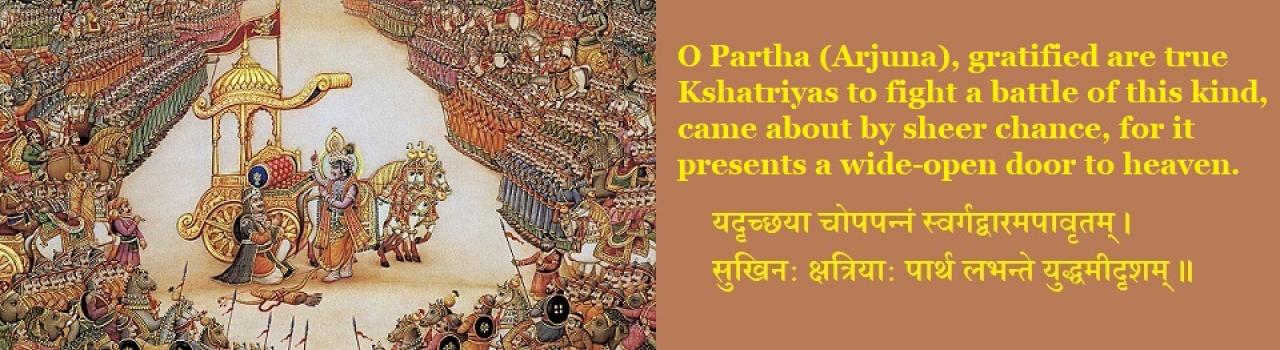
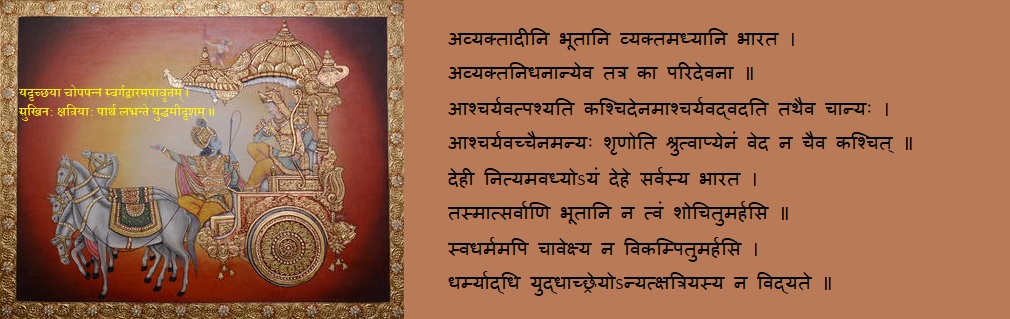
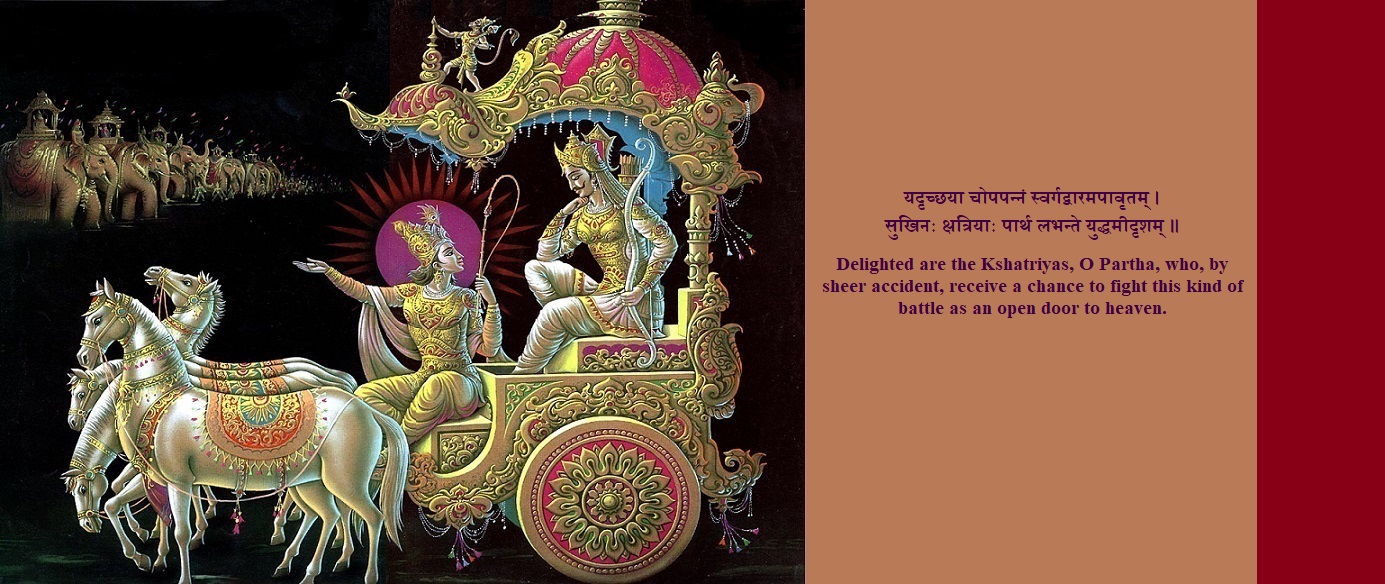
The exchange of arrows and missiles by the two armies began. Before the battle gained much momentum, Arjuna, in an extraordinary disposition, asked Kṛshṇa to stop his chariot in the middle, between the two armies, from where he could watch the ocean of soldiers assembled on both sides. Kṛshṇa promptly brought the chariot to the location in the middle, from where Arjuna observed the two armies.
[At that moment, Arjuna’s mindset of an accomplished warrior underwent a drastic change, but not a permanent one, as we recognize a little later. Despite the poet’s exhaustive graphic illustration of the change that takes place in Arjuna, none of the interpretations so far seem to state either the reason for the change or what the actual change he suffered from was. A fresh insight on this mystery, based on Vyāsa’s own words, will be part of the svādhyāya.]
Arjuna was overcome by a compassion of the highest order that seemed beyond all human emotions. He looked as though he was under a spell. Was it any magic performed by Kṛshṇa, the Absolute in human form? From the side of the Pāṇḍava army, Kṛshṇa, Arjuna’s charioteer, blew first his divine conch, Pāñchajanya. It was the turn of the supreme commander of the Pāṇḍava army to blow the conch and issue the challenge! Instead, did Kṛshṇa preempt the challenge by making the last call for peace, for he had made remarkable efforts to avert the war and now stood unarmed on the battlefield?
Arjuna, in an inexplicable state of compassion, surveyed all the soldiers assembled on both sides, including his family men and friends. He could not differentiate the people assembled there, since he saw only his own people wherever he looked! An uncompromising Arjuna told Kṛshṇa that he would not fight the battle, nor would he kill anybody, for he felt that the millions of soldiers on the two sides, standing ready to fight, were his own men. Or was he fantasizing so? His body was trembling, his skin burned, facial muscles contracted, eyes filled with tears, and his mind almost immobilized, but a singular feeling gave him goosebumps. In that strange state of mind, he blurted out a few reasons why he did not want to fight the battle. Kṛshṇa noticed his arguments sounded logical in parts, but were contrary to any philosophy worth pursuing. A few counter questions from Kṛshṇa forced him to give up all his logic and philosophy. He sat down in his chariot, in the middle of the battlefield, and pleaded ignorance of the way to attain what he wanted. Yet he was unable to spell out what he wanted. The terrible anxiety and the agonizing uneasiness were no more endurable, he found. Arjuna therefore asked Kṛshṇa for the best that a human being could ever attain (śreyas5), which alone he desired at that special moment.
Kṛshṇa recognized what Arjuna asked for, impelled by the peculiar circumstance, had a universal significance. Arjuna’s need, for a moment, meant the knowledge of the cosmic secret. Kṛshṇa then assumed the role of Arjuna’s wisdom teacher when the latter prayed to him with reverence to instruct him on the way to attain the supreme good (śreyas). A guru-disciple relationship unfolded in the battleground as Arjuna, unmindful of where he was, hankered for śreyas and only śreyas!
[What Kṛshṇa taught Arjuna at this crucial point is the Bhagavad Gita, a subsection in the Mahābhārata, which gained worldwide acclaim as “the Gita”.]
Kṛshṇa gave Arjuna lessons in Yoga Śastra, exhaustively covering the way to attain the śreyas he asked for. By the time the instruction in Brahma-vidya (the Science of the Absolute) had drawn to its close, he was ecstatic and confident. Kṛshṇa told Arjuna that he taught him the supreme wisdom and that it was now up to him to decide on its prudent employment. He regained his temperament of the war hero in him, and he stood up to fight.
[In a transcendental moment that came about by accident, Arjuna appeared to have a desperate desire for attaining śreyas. What did happen to him at the end of Kṛshṇa's instructions? The svādhyāya participants will see later that Arjuna’s unconquered ego-identity (karma sarīra) eclipsed his desire for śreyas and drove him toward preyas6.]
[5Śreyas: The highest value one can aspire to in life, which is attaining experiential knowledge of Brahman. 6Preyas: the aggregate of worldly values, comprising all sensual pleasures and material gains.]
[What the author of the epic poses before us is one of the greatest challenges of the commentators on the Bhagavad Gita. Just when the battle of Kurukshetra began, Arjuna had a strange experience, which dissuaded him from fighting. Stranger still was that he sought from Kṛshṇa the knowledge that would lead him to the supreme good, which he valued much above the sovereignty over the three worlds. He was fortunate to receive the perfect wisdom he asked for. Having gained the knowledge, he was joyous and far braver than ever and fought the battle. What do we make out of this episode?
Many commentators conclude: Kṛshṇa taught Arjuna (or rather convinced him) why he should not hesitate to fight the battle, which was his duty as a warrior; Arjuna understood and overcame his reluctance to fight. His duty as a Kshatriya (member of the ruling class), was to fight (and kill, of course), whether it was to defend his kingdom or to re-capture the one that was snatched by treachery. A Gita term the commentators take advantage of is svadharma. Every person has his/her personal duty (svadharma), defined by nature, and one should not hesitate to perform his/her genuine duty, at whatever cost it takes. Arjuna’s svadharma was to fight battles! We find such interpretations very often, defeating the very doctrine of the Bhagavad Gita.
One of the focus areas in our study will be to unravel the answer Sage Vyāsa has neatly wrapped within the golden verses of the Gita. However, let us raise right here a pertinent point for our contemplation. An extreme emotional state overwhelmed Arjuna, and he was about to back out of the battle. He then asked the way to attain the supreme good, or śreyas. What he asked for was not any lower ‘good’; rather there is no other good beyond this supreme good termed śreyas. Kṛshṇa began to teach him how to gain śreyas. Can the means to gain the ‘supreme good’ be fighting a battle and killing millions of fellow humans? War and violence have ever been abominable, whether in historic or prehistoric times.
Kṛshṇa taught the way to attain the supreme good and asked Arjuna to subject the instructions to deep contemplation before he decided what to do next. A reasonable conclusion then would be that Arjuna was still incapable of employing the philosophy he was taught. The svādhyāya will have a conclusive view researched and presented on this topic, and the basis will be nothing but Vyāsa’s expositions in the Mahābhārata.]
The Battle of Kurukshetra
On the first day of the battle, the Kauravas received shocking experiences from Abhimanyu and a few others of the Pāṇḍava army. However, at the close of the day, their army suffered huge casualties, which dampened the spirits of Yudhishṭhira. He found solace in the words of Kṛshṇa and mustered up his courage to endure the challenge.
The trend reversed on the second day. When Arjuna took on Bhīshma, the fight was ferocious. The loss to the Kaurava army was enormous. The carnage led primarily by Arjuna turned out to be far more terrible as Bhīma devastated the battlefield, as though death itself came down to horrify the scene. At sunset, Bhīshma even thought it prudent to stop the war, as the Kaurava army was already weary and dispirited.
A similar massacre continued on the third and fourth days of the war. The inconsolable Duryodhana wept throughout the night when he realized he lost many of his brothers by the end of the fourth day.
Duryodhana talked to Bhīshma and Droṇā in separate meetings in the night. He wanted to know why his army was not effective to defend themselves against that of the Pāṇḍavas. They both answered in similar lines that justice was with the sons of Pāṇḍu; they believed that the unarmed Kṛshṇa’s presence on their side worked as a great protective shield for them. Bhīshma reminded Duryodhana of his earlier advice that it was best to enjoy the pleasures of his share of the vast kingdom without challenging the righteous Pāṇḍavas for a war like this.
The carnage continued on the fifth day when heaps of dead bodies of soldiers, horses, and elephants of the two armies were visible everywhere, like mountains.
Days passed, and the sizes of the two armies depleted by hundreds of thousands every day. Bhīshma inflicted the most damage on the Pāṇḍava army. Arjuna’s son Irāvān died. Vengeful as they were, Arjuna and Bhīma retaliated and killed several of Duryodhana’s brothers. Even then, they would not secure victory as long as Bhīshma was on the battlefield and fought; Kṛshṇa reminded Arjuna of this reality. It was on the tenth day of the war, Arjuna stood behind the cover of Śikhandin, and sprayed hundreds of arrows on Bhīshma, who fell and lay on the ground, supported by the bed of arrows that pierced all over his body. [Bhīshma had taken a vow that he would not fight any person who was born a woman; Śikhandin, the reincarnation of the vengeful Amba, was a woman by birth and then became a man.]
Bhīshma would die only when he desired; he lay there waiting for the auspicious time when the sun would reach north most.
Karna, who refused to be on the battlefield as long as Bhīshma led the army, now joined the battle. On his suggestion, Duryodhana made Droṇā, the teacher of war science, to both the Kauravas and the Pāṇḍavas, the supreme commander of the Kaurava army. Droṇā led the army commendably and, in the next five days, he inflicted enormous damage on Duryodhana’s enemies. More confident Duryodhana grew than he was ever since the battle had begun. He now felt a little relaxed to contemplate a brilliant scheme to win the battle. If the Kauravas were to capture Yudhishṭhira alive, defeating the Pāṇḍavas would be much easier. He even dreamed of enticing the righteous Yudhishṭhira into another round of dice game and sending the sons of Pāṇḍu in exile for thirteen more years. The clever and resourceful Pāṇḍavas successfully thwarted every attempt of the Kauravas to take Yudhishṭhira captive.
Droṇā displayed his unmatched war skills by arranging a lotus formation of his army to combat the advancing Pāṇḍava troops. Arjuna was away, fighting another division of the Kaurava army. The young, valorous Abhimanyu, son of Arjuna and Subhadra, entered the lotus formation with remarkable skill and went ahead, destroying a large part of the army, giving a tough fight all alone. All the veterans among the Kauravas ganged together, attacked from behind, and killed Abhimanyu by treachery.
To the Pāṇḍavas, Abhimanyu was the apple of their eyes. His death threw them into unendurable sorrow. It added fuel to the fire in the hearts of the Pāṇḍava brothers.
Death rejoiced by dancing around in Kurukshetra. All prominent leaders and warriors succumbed to the unbridled fury of vengeance. Drupada’s son, Dhṛshṭadyumna, killed his father’s archrival, Droṇā, and fulfilled his life’s mission.
Bhīma brutally crushed Duśśahsana, who had once dragged Draupadi into the dice game hall and attempted to disrobe her. Petrified were Karna and Duryodhana at the sight of Bhīma drinking Duśśahsana’s blood to douse the fire of wrath he carried within him for thirteen years.
Karna’s prime goal in the Kurukshetra battle was to kill Arjuna; fate had its way all the same! Arjuna seized the only chance to slay his invincible rival when he was busy lifting his chariot-wheel from where it was stuck in the muddy field.
In single combat, a thunderous-looking Bhīma’s nasty blows inflicted horrendous injuries on Duryodhana, the last survivor among the Kaurava princes. Jumping on the prostrate body of the sworn enemy, the mighty Pāṇḍava stamped on his head and danced. Duryodhana lay fatally injured, waiting for his time to depart.
There were no more of the sons of Dhṛtarāshṭra to challenge the Pāṇḍavas. The two armies met with total annihilation. The only survivors on the Kaurava side were Kṛpa, Aśvatthāma (son of Droṇā) and Kṛtavarma (the Yādava army leader who fought for Duryodhana), and on the opposite side were the five Pāṇḍava princes, their supreme commander, Dhṛshṭadyumna, and the five sons of Draupadi. And of course Kṛshṇa, the unarmed.
Aśvatthāma found the brutal way Bhīma assaulted his master, Duryodhana, outrageous. The unforgiving loyalist sneaked into the Pāṇḍava camp at night and killed Dhṛshṭadyumna and the five sons of Draupadi while they were asleep. He then tiptoed in the pitch-dark night to the dying Duryodhana and triumphantly whispered in his ears about what he had done. Before he breathed his last, the Kaurava prince was in sheer ecstasy for a few moments, as though he tasted victory at last.
The Pāṇḍavas won the kingdom, but Yudhishṭhira, the king designate, had a deep realization that it was the moment of their defeat in life.
When Aśvatthāma was about to be caught by the Pāṇḍavas, he launched the deadly weapon, Brahmāstra, targeted to the yet-to-be-born baby of Abhimanyu’s wife, Uttara. Kṛshṇa intervened, extinguished the weapon, and left the baby safe in its mother’s womb. The baby was then born and known as Parīkshit, the only remaining descendent of the Pāṇḍavas.
The Pāṇḍavas left Aśvatthāma alive when Draupadi implored them not to kill him because he was the son of their guru, Droṇā, for the guru’s son was, in essence, the guru himself.
The Battle to Fight All Alone!
Yudhishṭhira, who committed his virtuous life to the practice of dharma, was overcome with remorse for his own decision to fight the war that led to the holocaust. He offered to end his life, for he regretted he did not choose the path of peace and renounce the kingdom to lead the life of a sannyasin. Yudhishṭhira entreated Arjuna to rule the kingdom and leave him free to live in the forests and do penance. Vyāsa consoled him with his supreme, soothing advice. Kṛshṇa concurred with Vyāsa’s words and further advised Yudhishṭhira of the essential dharma of a Kshatriya, of the greatest battle of his life he was yet to fight and win, but all alone!
As the auspicious time he was waiting for arrived, Bhīshma wanted to leave his mortal body. Before he did so, lying on his bed of arrows, he gave Yudhishṭhira his famous discourse on dharma. In his last moments, when Kṛshṇa was beside him along with the Pāṇḍavas, his eyes expressed his longing for the grace of the Supreme. Kṛshṇa was generous in fulfilling the Kuru patriarch’s last wish. He closed his eyes, enjoyed supreme bliss, and embraced the eternal slumber.
The Pāṇḍavas ruled the kingdom for thirty-six years. Dhṛtarāshṭra, his wife Gāndhāri, and Kunti went to the forests to spend their last days in penance. As predestined, Kṛshṇa’s clan destroyed themselves by fighting among themselves. Kṛshṇa himself withdrew from his human incarnation on earth and went back to his own Brāhmī-sthiti (the state of the Absolute).
Once Kṛshṇa left the stage of his earthly appearance, the sense of detachment from worldly interests overpowered the Pāṇḍavas. They gave up all their possessions, installed Abhimanyu’s son Parīkshit on the throne, and set out for mahāprasthāna, the final long journey, which was to continue until the end of their life.
The five sons of Pāṇḍu, along with Draupadi, went walking to the Himālayas. From the foothills, they kept climbing upward. On their way up, one by one, beginning with the youngest, fell dead—Draupadi, Sahadeva, Nakula, Arjuna, and Bhīma, in that order. Yudhishṭhira, who led them, knew when each one fell, but he kept climbing without turning back. Indra, the lord of svarga (heaven), came down and welcomed Yudhishṭhira. The spirits of Draupadi and the other four Pāṇḍavas had already ascended to heaven and Yudhishṭhira at last joined them, after having tested for the genuineness of his pursuit of dharma.
Dharma as explained in Svargārohana Parva of the Mahābhārata
Vyāsa’s disciple, Vyśampāyana says on Vyāsa’s behalf, “I am announcing aloud with my raised hands, but nobody listens: dharma is the source of artha7 and kāma8. Why do you all who desire artha and kāma not serve their source, dharma?”
“Owing to kāma (desire), fear and greed, never should human beings abandon dharma, not even for the sake of livelihood. If that results in death, let it be so. Even in the face of death, do not forsake dharma. Pleasure and pain are transitory, not eternal, whereas dharma is eternal; it is imperishable. The embodied (Ātman) is eternal. That which denotes its (Ātman’s) existence is not eternal ̶ that is, the body in which the Ātman pervades is transient.”
Vyāsa, before concluding the epic, thus makes clear what he means by dharma. Endorsing the eternal nature of both dharma and Ātman, he asserts that they both are the same, for there can be only one thing that is eternal. Therefore, he means dharma is the same as the eternal Truth—that is, Ātman or Brahman or the Absolute. The Sage exhorts the world to serve dharma relentlessly to attain perfection in life.
[7Artha: Worldly values such as wealth, means/objects of pleasure. 8Kāma: The desire to gain and own artha.]
--------------
(To read the next post [Gita Post #3] click/tap on this link: https://www.ekatma.org/node/175)
Comments (2)
Excellent. Now very clear how Bhagvad Geeta is part of Mahabharat. Must read this before studying Bhagvad Geeta.
Namaste!
Leave a comment