
What does a Mystic Experience Mean to a Seeker?

Sri Ramana Maharshi (1879 – 1950)
EXPERIENCE AS TOLD BY RAMANA MAHARSHI
Ramana Maharshi was still in his teens when he experienced a terrible crisis in his life. At the end of the crisis, he attained Self-realization! We have found Arjuna also in a crisis.
The Maharshi describes, “It was quite sudden. I was sitting alone in a room on the first floor of my uncle’s house (in Madurai, South India). I seldom had any sickness, and on that day there was nothing wrong with my health, but a sudden violent fear of death overtook me. There was nothing in my state of health to account for it, and I did not try to account for it or to find out whether there was any reason for the fear. I just felt ‘I am going to die’ and began thinking what to do about it. It did not occur to me to consult a doctor or my elders or friends; I felt that I had to solve the problem myself, there and then.
“The shock of the fear of death drove my mind inwards and said to myself mentally, without actually framing the words: ‘Now death has come; what does it mean? What is it that is dying? This body dies.’ And I at once dramatized the occurrence of death. I lay with my limbs stretched out stiff as though rigor mortis had set in and imitated a corpse so as to give greater reality to the enquiry. I held my breath and kept my lips tightly closed so that no sound could escape, so that neither the word ‘I’ nor any other word could be uttered. ‘Well then,’ I said to myself, ‘this body is dead. It will be carried stiff to the burning ground and there burnt and reduced to ashes. But with the death of this body am I dead? Is the body I? It is silent and inert but I feel the full force of my personality and even the voice of the ‘I’ within me, apart from it. So I am Spirit transcending the body. The body dies but the Spirit that transcends it cannot be touched by death. That means I am the deathless Spirit.’ All this was not dull thought; it flashed through me vividly as living truth which I perceived directly, almost without thought process. ‘I’ was something very real, the only real thing about my present state, and all the conscious activity connected with my body was centred on that ‘I’. From that moment onwards the ‘I’ or Self focused attention on itself by a powerful fascination. Fear of death had vanished once and for all. Absorption in the Self continued unbroken from that time on. …Whether the body was engaged in talking, reading or anything else, I was still centred on ‘I’ (Self or Ātman). Previous to that crisis I had no clear perception of my Self and was not consciously attracted to it….” [As recorded in The Mind of Ramana Maharshi by Arthur Osborne, Jaico Publishing House, Mumbai.]
The uniqueness of Ramana Maharshi’s experience is that “this whole sādhana took barely half an hour,” when he could gain the Supreme wisdom and become a Brahma-jñāni. “He (the Maharshi) warned them (the sādhakas or seekers) that the consummation towards which it leads is not normally attained quickly but only after long striving…” [The Mind of Ramana Maharshi by Arthur Osborne, Jaico Publishing House, Mumbai.]
ŚRĪ RAMANA BECOMES A JÑĀNI WHILE ARJUNA REMAINS A WARRIOR
Arjuna was also (as Ramana Maharshi asserts in his own case) perfectly healthy and cheerful when he arrived on the battlefield. He had no previous history of any anxiety syndrome or mental depression. The Maharshi was overtaken by “a sudden violent fear of death” as an indication of the mystical experience to follow. What have we seen in Arjuna? The onset of his kshudra samādhi created in his mind total confusion, followed by deep compassion towards all the soldiers on the battlefield; as with Ramana Maharshi, he was also overtaken by fear! To Arjuna, it was (a) the fear of death of all the soldiers marshalled on the battlefield and (b) that of becoming a sinner (and living in hell) by killing, even though some amongst the enemies were despicable criminals. We thus note that the symptoms of the mystic experience appeared as a shock to both the Maharshi and Arjuna. Bewildered over the imminent death of the soldiers, Arjuna’s body was immobile and his mind was whirling. He dropped into his chariot seat as though he was half-dead! Kṛshṇa chided him for his unworthy behaviour. Now we could guess why. People have been interpreting that Kṛshṇa was finding fault with Arjuna for his refusal to fight the battle against the Kauravas. In reality, Bhagavān did so for his inability to stand erect and face the debilitating experience of the Transcendental (para) came upon him at that moment.
What was Arjuna’s experience? Vyāsa says: parayā āvishṭhaḥ ̶ overpowered by the Transcendental (Brahman); so it was a mystic experience. We have just seen the example of Ramana Maharshi, a very young man in his teens, who could think clearly, with a one-pointed mind, even when the fear of death overtook him. The Maharshi himself mentioned that it had occurred as a terrible shock. In his case, we now clearly know that it was the onset of a mystic experience which resulted in Self-realization.
Mystic experiences come in different forms. The other two real-life cases we already discussed elsewhere and that of Arjuna were short-lived experiences (kshudra samādhi) came about as surprises. Ramana Maharshi was also taken by surprise; however, he had the essential qualities Kṛshṇa wanted Arjuna to exhibit, that is, not to be flustered and mentally distressed, to be calm and composed, and to take advantage of the kshudra samādhi to attain full Self-realization! Arjuna had the reputation for his unique ability to withstand extreme difficulties as a fighter in physical battles. Here, he miserably failed to deal with ‘what he faced’ at this critical spiritual moment.
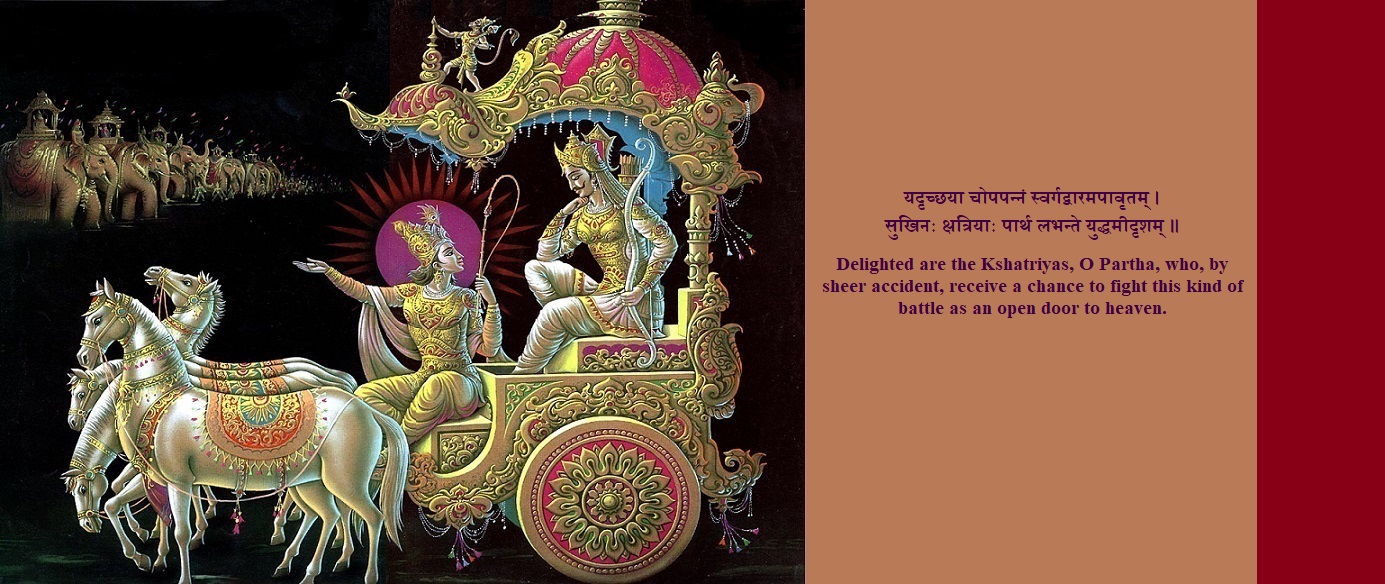
Among many other factors, the ability to remain in perfect calmness, think cogently and immerse himself in deep meditation on the Self at that very ‘blessed’ moment would have been a few important ones that led the Maharshi to full Self-realization. The blessed moment came about as a sheer accident, to quote Vyāsa’s words. In Arjuna’s case, Kṛshṇa signaled him that the unexpected mystic experience that overtook him was an exceptional opportunity to attain the Supreme state of wellbeing (Śreyas); it was the same thing Arjuna asked for in the beginning of Chapter 2. The all-knowing Sage could describe with precision all the detailed symptoms of such a short mystic experience, which shattered Arjuna who was least prepared for Self-realization. In total contrast, Maharshi Ramana could instantly recover from the initial shock and collect himself; so he was not afflicted by the various symptoms of anxiety syndrome which Arjuna could not escape. Because of some inner force and the preponderance of the sattva (one of the three modalities of Nature), the Maharshi could avail himself of the incredible opportunity that came as an utter surprise. What Bhagavān reminded Arjuna in verse 32 of Chapter 2 is also nothing different. There Kṛshṇa said, ‘This kind of battle that has come to you as an accident is a very rare occurrence; delighted are the Kshatriyas who get such a chance, so you should be the happiest.’
Let us recollect Ramana Maharshi’s warning that “the consummation towards which it (the initial mystic experience) leads is not normally attained quickly but only after long striving…” Whether it was going to be long or short, the same “striving” was the battle Kṛshṇa enjoined Arjuna to fight.
Vyāsa wrote the Bhagavad Gita several millennia ago. We see even in modern times that what Kṛshṇa asked Arjuna to strive for still works. The wise thus keep showing the world how the eternal Reality operates.
We presume this analysis will bolster our confidence in the interpretation that Arjuna did go through a passing mystic experience and why Kṛshṇa was encouraging him to fight the spiritual battle.
------------------------------

Leave a comment