
The Bhagavad Gita, Chapter 2, Verses 5 ... 8
Gita Post #14
[In the previous verse, we have heard Arjuna saying: O Madhusūdana (Kṛshṇa), in this battle, how will I fight with arrows against Bhīshma and Drona who are worthy of worship, O Arisūdana (Kṛshṇa)?]
Translation
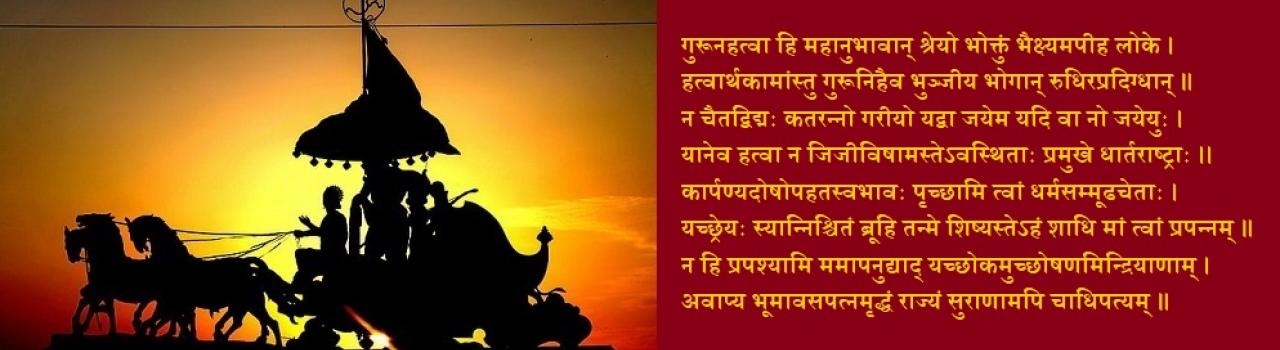
In this world, it is superior indeed even to live on the frugal meal of a beggar, desisting from killing the highly revered gurus; but after killing the gurus, although they are wealth-craving, in this world I enjoy only blood-stained luxuries.
Annotation
‘Life of begging’ is the way prescribed by tradition for sannyasins in India. Perhaps Arjuna thinks that a beggar-sannyasin’s life is much better than a contemptible life after killing such highly honorable gurus. In his present self-sacrificing mood under the influence of para, he must be experiencing, at least faintly, the thrust to seek wisdom; so he feels the life of a beggar-sannyasin is of far better value. The word śreyaḥ (of supreme value) he uses is an indication. The thought sounds noble; does he then recognize that the life of a genuine sannyasin is not just begging for a meal, and how exacting are the qualifying standards that make one an ideal sannyasin? [In verse 46, Chapter 1, Arjuna prefers his own death to the killing of others. He has spoken of his wish to die in the battle by staying unarmed and unresisting. Here again we see the expression of the same self-sacrificing mood.]
As a Kshatriya (a member of the ruling class), Arjuna has a dharma (his naturally suited function or vocation). As long as he remains a Kshatriya, he must adhere to it. Of course, he has the choice to become a sannyasin too if he could live up to what is expected of a sannyasin. What he may not be aware, at this moment, is that there is a common goal for all human beings, as the Gita instructs. Once that is understood, whether one is a Kshatriya or a Brāhmaṇa or of any other class or community is of no importance. What is important is the perfect performing of each one’s dharma, the function expected of each one based on the qualities endowed by Nature.
Arjuna uses the term mahānubhāvān gurūn (महानुभवान् गुरुन्) to qualify Bhīshma and Drona. It means great magnanimous or compassionate gurus. In the verse immediately before, he has said they are worthy of worship. [It seems Arjuna tries to apply the principle of the mantra: “Guru is verily the Supreme Brahman” (guru sakshāt param brahmaḥ)]
This description of gurus applies to the wise ones who are Brahma-jñānis ̶ the gurus who lead genuine seekers to attain the knowledge of Brahman. The distinguishing characteristic of such gurus is that they will not be warriors in a bloody battle like this. To defend himself in the face of Kṛshṇa’s acerbic rebuke, perhaps Arjuna has struggled to make his point credible-sounding. But Arjuna is known for his humility, especially in dealing with his teachers and elders; from that angle, the usage of mahānubhāvān gurūn is understandable.
Then, in the second line of this verse, he also says Bhīshma and Drona are artha kāmān (अर्थ कामान्), means wealth-craving. Greedy! This contradicts the view that they are great compassionate or magnanimous gurus. It will be interesting to recollect our earlier discussion of verse 9, Chapter 1, where Duryodhana has used the word madarthe when describing the heroes in his army. Arjuna’s comment artha kāmān about Bhīshma and Drona corroborates the implied meaning of madarthe (for the sake of my wealth) interpreted there by us.
In this world, Arjuna finds, in fact, only one possibility for him: “enjoy only blood-stained luxuries.” It is no better than hell. To evade that possibility, again he has within his awareness only just one option: volunteer to die in the war and live in heaven. Of course, he has said it is better to be a beggar than killing the gurus, but the statement is only of rhetoric value. He himself subtly expresses it is not a feasible option for him. The present verse thus verbalizes Arjuna’s dilemma. Later, in verses 7 and 8, he admits his inability to conclude what the right decision is from the point of view of dharma.
We should note an important aspect about the style of the Gita. By illustrating Arjuna’s confusion and dilemma, the poet shows his insistence on considering the opposing views before the final siddhānta (doctrine) is presented. This style is similar to the dialectical method used by the ancient philosophers of the West.
Translation
We do not know which would be of greater merit for us: that we conquer them or that they conquer us. Those sons of Dhritarāshṭra, after killing whom we do not wish to live at all, stand arrayed against us in the battle.
Annotation
The poet here again establishes that, for the time being, Arjuna is not in the relative world, but is still under the sway of para (the Supreme). Otherwise, who will speak these words? Arjuna unequivocally conveys that the war (or any war) is objectionable. He cannot decide whether winning or being vanquished is good because in a war there is no option that is good for everybody. He speaks for the equitable well-being of all his fellow men (svajanaḥ), the millions on both sides of the battlefield.
We have seen the sons of Dhritarāshṭra are also part of Arjuna’s vision of svajanaḥ. To him, at this moment, the thought of killing any living being is suicidal because in the domain of para, everybody is a manifestation of the same Ātman, so all are his svajanaḥ.
The Mahābhārata proclaims more than once that ahimsa (non-killing or non-hurting) is the supreme dharma (ahimsā paramo dharmaḥ). Perhaps the author wants to show right at the beginning of the Bhagavad Gita how the all-powerful para induces Arjuna to convey the message of ahimsa of the highest degree. No wonder he prefers his own death to allowing the death of the others.
We again note that Arjuna continues to use the inclusive ‘we’ and ‘us’. Anyone having the slightest awareness (śraddhā) of the truth of non-duality (advaita) will have difficulty in using the singular ‘I’. Since Arjuna, in the mystic state, experiences the vision of non-duality in all beings, he sees himself as the collective Self of humanity, so he speaks for the world.
At the zenith of his mystic vision, Arjuna himself undergoes a dramatic but profound change!
Translation
My vitiated mind, lacking the discriminating wisdom, is bewildered owing to my incompetence at dharma. So I would ask you to reveal that which is definitely of supreme merit (śreyaḥ) to me. I am your disciple. Instruct me who has taken refuge in you.
Annotation
In the end, Arjuna recognizes he cannot anymore continue arguing with Kṛshṇa because (a) he has a vitiated mind that lacks the ability to discriminate between Truth and non-Truth, (b) he is not competent to decide what dharma is, and consequently (c) he is in utter confusion. What makes him suddenly admit his shortcomings? First, he can no more tolerate the delay in bringing dharma into effect, for he must save humanity (svajnaḥ). But most significantly, he would have just recognized to whom he has been speaking ̶ of course, to his charioteer-friend, his cousin, his brother-in-law, but now only it occurred to his grieving mind that he has Bhagavān himself before him. (We have discussed the definition of Bhagavān elsewhere: Bhagavān is the Guru who can provide the instructions that enable the seekers to cross bhava sāgara and be liberated from all worldly suffering. To read the details, please click/tap on this link to Understanding Krishna.) Arjuna has been suffering! He is desperate to be out of his present misery.
At this stage, when the instruction of Brahma-vidya is about to begin, the Sage has put philosophically relevant words into Arjuna’s mouth. When he says his mind lacks the ability to discriminate between Truth and non-Truth [kārpaṇya dosha (कार्पण्य दोष)], that ability is the nitya-anitya-viveka Śaṅkarāchārya explains in Viveka-chūdāmani. In the first half of this chapter, what Krishna teaches as Sāṅkhya buddhi directly addresses the human defect of kārpaṇya dosha.
Arjuna’s second problem is his incompetence at deciding what dharma is. [He says he is dharma-sammūḍha (धर्म सम्मूढ) => (my mind) is bewildered owing to my incompetence at dharma.] Philosophically, here dharma refers not to the duties and functions of the relative world, but to the absolute dharma (of Brahman’s domain) as the ‘standard’ against which one has to make the right decisions on one’s course of actions. Baffled is a person who suddenly gets the urge to perform only perfectly right things in life, because deciding the perfect way to act looks impossible. We see something inappropriate in every action (karma) we contemplate, and each action we decide upon will look like a compromise. Whether perfect or imperfect, actions (karma) are inevitable in life. As the answer to this problem, the second half of this chapter teaches Yoga-buddhi.
What Arjuna asks is for that which is of supreme merit (śreyaḥ) to him. In this chapter itself, Kṛshṇa states that reaching the state of yoga or the state of being in Brahman is what is of supreme merit. When Sāṅkhya buddhi and Yoga-buddhi of a seeker works in unison as buddhi-yoga, he/she becomes a sthita-prajña. One is a sthita-prajña when one has attained the state of yoga by following buddhi-yoga and holding his buddhi (final self-awareness of Reality) ever steady, unshaking and perfectly still.
At this moment, as Arjuna himself says, he has taken refuge in Kṛshṇa, for he is now the supreme Guru to teach him the way to attain śreyas. Śreyas is a word of philosophical relevance in this verse. We have seen earlier that Arjuna is a firm believer in heaven. He has consoled himself that he would live in heaven if he were to be killed in the battle, unarmed and unresisting. But here he admits he does not know what will bring him supreme merit; notwithstanding, what he wants is supreme merit, and he calls it śreyas. [In other contexts, the word śreyas is also used to mean wellbeing.]
In Vedanta philosophy, śreyas is the highest value one can aspire to in life ̶ moksha or mukti (Liberation) by gaining the wisdom of Brahman (Brahma-jñāna). And preyas is the aggregate of worldly values, comprising all material gains, including the kingdom and the pleasures of heaven.
Translation
Even if I am to gain the unchallenged, prosperous kingdom on earth or even the supremacy over the gods in heaven too, I see not that which relieves my distress that burns the senses.
Annotation
Arjuna’s words bring out the enormity of the distress he goes through. He is convinced that nothing of material value, not even the supremacy over all the worlds, can relieve him of the distress he suffers. Has it occurred to him just at this moment? No, he has had it in him all the time. We all have similar distress within us. To him, it has just surfaced all of a sudden. When karma sarīra is dominant, the concern for the ‘whole’ (samashṭi) is significantly attenuated by the interplay of countless desires (kāma) that drive every individual (vyashṭi or microcosm). If karma sarīra is subdued (for any reason), dharma residing deep within the same individual occupies the throne of the conscious mind. The immediate effect could be an unbearable distress owing to all the personal failures so far in fulfilling one’s natural karma for the wellbeing of the whole (samashṭi or macrocosm). Natural karma, which the Gita calls svadharma, means the original function ‘intended’ by Nature for each individual entity.
The Kurukshetra battle that has already begun does not worry Arjuna at all. There is a harder battle to fight at once, as his words reflect; but he is oblivious to the fact that, as a Kshatriya, these few moments are the most critical time in his life.
Arjuna has a sense, though not obvious yet, that there is something which ends all sufferings and brings perfect peace and happiness in life. He wants to get there. Heaven is not that which can ease the acute distress that has upset his body and mind; more or less, this is the conclusion he arrives at in this verse. That ‘something’ of supreme merit (śreyaḥ) and the means to achieve the same seem much higher in value than all the power, wealth, fame and the pleasures of this world he could win; this recognition is a vital step for anyone who embarks on the spiritual journey. At this instant, he sees no value in preyas. The karma śarīra, which keeps dancing to the tune of kāma (desire), lies dormant in him at this very moment; and he implores Bhagavān Kṛshṇa to save him by teaching the way to attain śreyas.
Everybody receives in some rare moments a feeble call from within to pursue the path to śreyas. Unless we tune ourselves to listen to that voice, it goes unnoticed. Learning the Gita, we train ourselves to listen to the inner voice.
--------------------
(To read the next post [Gita Post #15] click/tap on this link: https://www.ekatma.org/node/194)
Leave a comment