

A Call to Save the World!
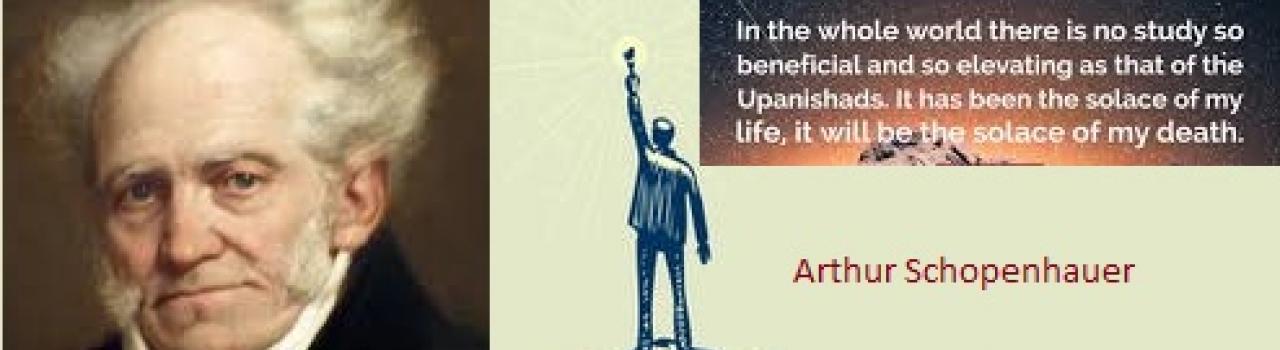
The nineteenth-century German Philosopher, Arthur Schopenhauer was one of the first Western philosophers of modern times to acknowledge and assert the inestimable value of the ancient Indian philosophy. He became the proponent of the Vedantic principle that the world is an appearance.
Will Durant in The Story of Philosophy paraphrases Schopenhauer’s views on Vedanta, ‘The Hindus were deeper than the thinkers of Europe, because their interpretation of the world was internal and intuitive, not external and intellectual [we have seen that modern physics is at a point of agreeing with this view]; the intellect divides everything, intuition unites everything; the Hindus saw that the “I” is a delusion; that the individual is merely phenomenal, and that the only reality is the Infinite One- “That art thou.” Whoever is able to say this to himself, with regard to every being with whom he comes into contact, is certain of all virtue and blessedness, and is on the direct road to salvation.’
Schopenhauer wrote he found everything that he wanted to say in the Upanishads. In his enthusiasm, he declared that the Upanishadic philosophy (Vedanta) would displace other beliefs and philosophies in Europe. Like any great philosopher who desires the well-being of the world, he wished humankind everywhere could enjoy the benefit of the perfect value he saw in Vedanta philosophy. But, the trend does not look favourable for his vision to materialize; the global dominance of materialism, thriving with its associated evils, over genuine spirituality is a cause for concern.
In the preface to the second edition of The Tao of Physics, Fritjof Capra wrote: “…. Thus, the awareness of the profound harmony between the (new) world view of modern physics and the views of Eastern mysticism now appears as an integral part of a much larger cultural transformation, leading to the emergence of a new vision of reality that will require a fundamental change in our thoughts, perceptions and values.” Let us reflect on what it means.
The mechanistic world view derived from Descartes’s philosophy is that the mind and the matter are of two different realms. Such a view has done tremendous damage to the world, according to Capra. Let us look at his concern:
“The natural environment is treated (by the world that followed Descartes’s philosophy) as if it consisted of separate parts to be exploited by different groups.
“It (the mechanistic world view) has alienated us from nature and from our fellow human beings. It has brought a grossly unjust distribution of natural resources, creating economic and political disorder; an ever-rising wave of violence, both spontaneous and institutionalized, and an ugly, polluted environment in which life has often become physically and mentally unhealthy.”
Even after forty-five years since the first release of the book, the “fundamental change in thoughts, perceptions and values” Capra dreamed of is yet to take place. Can it happen in a world that has become the slave of sensual pleasures? Will humans worldwide recognise that ethics and morality are fundamental to the survival of humanity?
In that context Capra remarks, “Scientists, therefore, are responsible for their research not only intellectually but also morally.” Shall we add technologists, businesspersons and political leadership in the list of those who should be responsible morally as well as intellectually?
A resounding “Help Save the World” we hear in Capra’s words. There are many who share similar views, but we intend not to quote them exhaustively but to keep the awareness alive.
Edwin F. Bryant, a scholar in the Indian systems of philosophy, says as he introduces his magnificent book on the Yoga Sutras of Patañjali:
“According to almost all schools of Indic thought, including Buddhism and Jainism, the more we desire, the more we are frustrated. The more we are frustrated, the more we strive to remove our frustration with more sensory stimuli. And the more we strive, the more we damage ourselves and our environment, and perpetuate our samsaric existence.” [Samsaric existence: apparent existence entailing constant flow of events because of which emergence and merging–births and deaths–of visible forms always happen. It is commonly used in the sense of “life of worldly sufferings.”]
“…. It is this attitude that the ancient spiritual teachers of India such as Patañjali were so concerned to redress, and it is in this regard that the teachings of yoga will remain perennially relevant to the human condition.” [Note on yoga: Bryant does not refer to the yoga exercise packages now sold worldwide.] [Since 2001, Edwin F. Bryant, a Ph.D. from Columbia University, has been professor of Hindu religion and philosophy at Rutgers University. Earlier he taught in Columbia University and Harvard University]
The task before humankind:
It is imperative to recognize the unitive nature of Reality, whether we follow the 1sādhana-centric Patanjali Yoga or Vedanta that blends both the philosophy of the 2sādhya and the sādhana. Animated by a common single soul or Ātman, living beings are not separate individuals in the spiritual sense. They are rather the manifest forms of the same causal source, Brahman or the Absolute. Outside Its domain are the human-made divisive devices such as religion, sects, creed, and social status. Discriminating people on the grounds of those artificial devices has no spiritual sanction. In essence, competing tendencies among humans are only self-damaging, for living beings are one soul in different bodies. Hence, Nature expects them to love one another and live in peace. Therefore, they had better reinvent the way to live in perfect harmony among themselves and at once with Nature.
If the world still understands and recognizes the meaning and value of peace, morality, in its genuine sense of dharma, will be back in life. The leaders of the nations must together work out a governance model that ensures global harmony. They should work to free the world from discrimination among people(s) and preferential treatment for a few. Is it a realistic dream? According to the ṛshis, it happens when humans accept the truth that the world is an integral whole (or, unitive by nature). The philosophy we discuss illustrates the interesting qualities of the state leadership who will bring about a comprehensive transformation, heralding an era of peace, harmony and happiness.
In a concluding article ̶ Is Vedanta a Religion? ̶ of this section of the website, we will have more reasoning why Vedanta, if taken seriously, is the philosophy that addresses the challenge confronting humanity.
[2Sādhya: the object of the seeker. 1Sādhana: the practices to attain the sādhya]
[The word Nature with a capital ‘N’ is used as a proper noun.]
The Benefits from the Study of Vedanta
- Not all of us want to become erudite philosophers.
- The study of Vedanta would enable a personal transformation ̶ a fundamental change in our thoughts, perceptions, and values. A life of inner calm and lasting happiness is what one gains.
- A Vedantin is free from the fear of death. The philosophy declares unequivocally that the sincere seekers attain absolute contentment and liberation from the ‘bondage’ of the worldly ties.
- Perhaps the most important benefit to the world: here we learn how to experience that all beings, living or non-living, are manifestations of the one all-pervading Truth, Brahman. Every one of us is nothing but the same Brahman. At present, we do not experience it, owing to a ‘misfortune’. Most of the study is about this Vedantic truth, and we learn how to overcome that misfortune. A deep and sincere intellectual understanding of this profound doctrine will bring in anybody an awakening to one’s dharma (naturally suited role in the world), let alone the final liberation. It keeps people stay uninfluenced by any narrow considerations. Even one person’s transformation is of incredible advantage not only to the individual but to the entire world.
The full benefit of the philosophy, simply put, is as a guide to Liberation (Beatitude or Self-realization). But we know it is not an easy goal to achieve. (Of course, not impossible.) Then, what is its advantage? All its advantage is in the learner’s faith (śraddhā3) in the philosophy. (See the note below on śraddhā.) In the light of the present conclusion of modern physics (or for any other good reason), let us say we have complete faith in the doctrine's veracity — an intellectual belief in Brahman as the Truth. If we learn the philosophy with such faith, it will continue to stay in our minds as a philosophy in which we have full faith. Yet the modern lifestyle we are used to may pose a serious impediment to adopting a way of life that conforms to the philosophy. We will find it too rigorous to practise. Problem? Let us then forget the goal of Liberation (moksha or mukti) at the moment. The philosophy still stays in the mind and the unwavering faith in it will make it dearer to us; brings it closer to our hearts. There we have the benefit. As long as the philosophy stays dearer to us, every thought, action and behaviour of ours will have its subtle but significant influence. That is a new evolution of the person, often an unconscious process. This results in a positive transformation of our personality. It is this change that brings tremendous value to oneself and the world at the same time. That explains the bare minimum advantage of familiarizing ourselves with the principles of Vedanta. A deeper understanding of the philosophy will show how meaningful this point is.
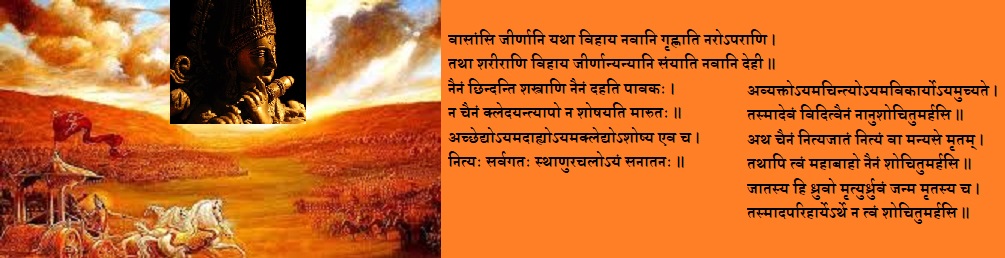
[3Śraddhā: We have discussed many times that the ultimate Reality, Brahman, is indescribable in any factual language and is not sense-perceivable. We then have found It is the essence of every individual being, the knowledge of which alone can take us to higher levels of contentment in life. It means humans cannot afford to ignore their own essence, the Reality or Brahman. Then how will we know that Reality? Depend on those who know It already! There is no other way out. Only they can help. And they are always willing to help. Who are they? The ṛshis, the wise teachers, who live experiencing their oneness with the Reality. If we, as seekers of the Reality, approach one such wise person, we will benefit only if we have full faith in his words, because he is trying to connect us with the indescribable, the Reality that is not sense-perceivable. When one develops absolute faith in the wisdom teaching of the ṛshi, such faith is śraddhā according to Vedanta. Then the ṛshi himself says if you have no access to a wise teacher, learn from śruti with absolute faith (śraddhā), for they are nothing but the teachings of the ṛshis. For a student of Vedanta, śruti means the Upanishads or any other scripture such as the Bhagavad Gita, having the equivalent status of śruti.]
[ To visit the Bhagavad Gita Self-Study page, click/tap on this link: Bhagavad Gita Svādhyāya]
--------------
Leave a comment