

Modern Science Meets the Philosophy of Mystics
The advancements in quantum mechanics and particle physics have brought a dramatic change in the attitude of twentieth-century scientists towards Eastern mysticism and the Vedanta philosophy in particular. Many modern physicists began looking at the Upanishadic teachings of India to derive not only inspiration but the concepts on how the universe functions!
Fritjof Capra, an experienced research scholar in modern physics, wrote in his book, The Tao of Physics: “The fact that the mass of a particle (such as an electron) is equivalent to a certain amount of energy means that the particle can no longer be seen as a static object, but has to be conceived as a dynamic pattern, a process involving the energy which manifests itself as the particle’s mass….
“After (Paul) Dirac’s discovery, the whole question of the division of matter appeared in a new light. When two particles collide with high energies, they generally break into pieces, but these pieces are not smaller than the original particles. They are again particles of the same kind and are created out of the energy of motion (“kinetic energy”) involved in the collision process…. The subatomic particles are thus destructible and indestructible at the same time.” An earlier discovery in quantum mechanics proved electrons were waves (of continuous form) and particles (distinct entities) at once. Paradox after paradox in scientific discoveries!
Several millennia ago, the ancient Indian philosophers (the ṛshis or the wise teachers) described the truth behind the universe in a style that sounded often paradoxical. In the light of these modern discoveries, the significance of the words of the ṛshis should be understandable.
As an example, the śanti pātha of the Shukla Yajurveda reads as follows:
The explanation of the mantra: Being the ultimate Reality and the primal cause of everything, that (Brahman) is complete. Brahman Itself appears as this (universe) as well. Therefore, because of the completeness of the cause ̶Brahman, this (universe) is also complete. Now, when completeness subtracted from completeness, what happens? Brahman does not change by Itself nor can anybody force a change in It, so It is always complete. However, with the inherent power, It has caused the appearance of the universe, which we have found to be complete as well. In this process, did Brahman lose anything even though It has given completeness to the universe? No! It continues to be complete because It does not undergo any change. The second half of the mantra explains this aspect of Brahman.
Although the mantra may sound illogical to us even with some explanation, the wise ṛshis strived like this to describe the indescribable Reality they learned by methods of intuition. Now modern scientists are getting used to living with similar challenges.
The ṛshis knew that no one could verbally express the complete knowledge of the Reality, nor could the novice seekers visualize or experience It on their own. So they emphasized the importance of a knower of Brahman as a guru. Such a guru could lead the seekers in their pursuit of the Reality, by methods that physical sciences have not yet conceived what they must be like.
In modern science, we are at a stage where the discoveries or observations of one scientist are neither conceivable to others nor describable in words. Fritjof Capra explains an interesting situation scientists faced in particle physics research:
“Relativity theory has not only affected our conception of particles in a drastic way, but also our picture of the forces between these particles. In a relativistic description of particle interactions, the forces between the particles‒that is, their mutual attraction or repulsion‒are pictured as the exchange of other particles. This concept is very difficult to visualize. It is the consequence of the four-dimensional space-time character of the subatomic world and neither our intuition nor our language can deal with this image very well.” [The Tao of Physics]
Vedantins say the universe is a continuous flow or flux the eternal Reality or Brahman presents. That Reality keeps manifesting all forms we perceive and merging them back into Itself. Brahman appears as the universe, which has no separate existence. Another way to understand is that Its true nature is beyond the perception of sense organs, but It assumes the sense-perceivable appearance of the universe.
Here is how modern physics endeavours to rediscover this Truth expounded by the ancient ṛshis:
“The striking new feature of quantum electrodynamics arises from the combination of two concepts: that of the electromagnetic field, and that of photons as the particle manifestations of electromagnetic waves. Since photons are electromagnetic waves, and since these waves are vibrating fields, the photons must be manifestations of electromagnetic fields. Hence the concept of a ‘quantum field’: that is, of a field which can take the form of (either) quanta or particles…. In these ‘quantum field theories’, the classical contrast between the solid particles and the space surrounding them is completely overcome. The quantum field is seen as the fundamental physical entity: a continuous medium which is present everywhere in space. Particles (take them as matter) are merely local condensations of the field; (particles are) concentrations of energy that come and go, thereby losing their individual character and dissolving into the underlying field. In the words of Einstein: ‘…. There is no place in this new kind of physics for the field and matter, for the field is the only reality.’ ” [The Tao of Physics]
Vedanta says matter (jada) is transitory, and it undergoes constant change. The findings of the quantum physicists give the same impression. But the all-pervading Vedantic Reality (Brahman) has no properties of the quantum field they have discovered. Having no properties, It is indescribable! What modern physics discusses should only be the tip of the iceberg. The scientists suggest the quantum field occupies the entire universe, or the universe is a mass of the field. If matter keeps switching states between waveform and particles, it should happen in the physical bodies of living beings as well. The same applies to the air surrounding each body, suggesting a continuous waveform alone fills the world rather than individuals and discrete entities. The task ahead of modern science is to discover that Reality (behind the state-switching waves and particles), which has no properties to describe.
The Tao of Physics indicates that as well, “This reality of the Eastern mystics cannot be identified with the quantum field of the physicist because it (the reality of the Eastern mystics) is seen as the essence of all phenomena in this world (world here means the universe) and, consequently, is beyond all concepts and ideas. …The Brahman of the Hindus, like the Dharmakaya of the Buddhists and the Tao of the Taoists, can be seen, perhaps, as the ultimate unified field from which spring not only the phenomena studied in physics, but all the other phenomena (of the universe) as well.”
Further, it says, “In modern physics, the universe is thus experienced as a dynamic, inseparable whole which always includes the observer in an essential way. In this experience, the traditional concepts of space and time, of isolated objects, and of cause and effect, lose their meaning. Such an experience, however, is very similar to that of the Eastern mystics.” Vedanta has always declared that when a seeker arrives at the ultimate vision of the Reality, the knower (the subject), the known things (the objects), and knowledge (of the objects) merge into Brahman, and That alone is Truth.
The focus has then switched to the research to discover the “unified quantum field” ̶ “the essence of all phenomena in this world” as the scientists speculate. They realize the general relativity theory and the quantum theory are only part theories. A theory which marries them both, they believe, is the one that could lead to the discovery of the unified field. Will it resolve the mystery of the universe forever? The many theories further proposed, such as the bootstrap theory of Geoffrey Chew and the S-matrix theory of David Bohm, also stay part theories. Chew and Bohm have asserted that any future research on the final theory must include the human consciousness! They mean the human consciousness is not a quantum field they could experiment with within the laboratories.
In his popular blog by the name of Cross Check, John Horgan wrote: Bohm rejected the claim of physicists such as (Stephen) Hawking and (Steven) Weinberg that physics can achieve a final “theory of everything” that explains the world. Science is an infinite, “inexhaustible process,” he said. “The form of knowledge (in science) is to have at any moment something essential, and the appearance can be explained. But when we look deeper at these essential things, they turn out to have some feature of appearances (means non-Reality). We're not ever going to get a final essence which isn't also the appearance of something.” [John Horgan of the Center for Science Writings at the Stevens Institute of Technology interviewed David Bohm in August 1992.]
Bohm refers to a final essence which is not an appearance; it is the Reality. He implies that the final essence is not any empirical knowledge. He says it is beyond the reach of the physical sciences.
John Horgan, in another blog: Recently, physicist Edward Witten came out as a mysterian. Witten is regarded with awe by his fellow physicists, some of whom have compared him to Einstein and Newton. He is largely responsible for the popularity of string theory over the past several decades. String theory holds that all of nature's forces stem from infinitesimal particles wriggling in a hyperspace consisting of many extra dimensions…. But in a fascinating video interview with journalist Wim Kayzer, Witten is pessimistic about the prospects for a scientific explanation of consciousness. … Here is an excerpt:
“I think consciousness will remain a mystery. Yes, that's what I tend to believe. I tend to think that the workings of the conscious brain will be elucidated to a large extent. Biologists and perhaps physicists will understand much better how the brain works. But why something that we call consciousness goes with those workings, I think that will remain mysterious. I have a much easier time imagining how we understand the Big Bang than I have imagining how we can understand consciousness....”
Now we have heard three major scientists (Chew, Bohm, and Witten) of recent times who affirm that the final theory will be incomplete without going deep into consciousness. But how can they do it in the laboratory environment? They think consciousness will remain a mystery to modern science. Witten’s remark is very significant. He implies that the knowledge of the Reality is essential for human progress, but the present research methods of physical sciences are inappropriate for the purpose. Or scientists have reached an inflexion point from where they have to switch their methods. It is as good as admitting the ultimate Truth is mystic by nature, so follow the ṛshis to unlock the ever-elusive secret of the universe. Vedanta is a spiritual science that teaches how to experience that the individuated soul and the Soul of the universe are one and inseparable.
Stephen Hawking displayed high optimism that modern science would unravel the mystery of the universe and then God would be of no significance. He, along with a majority of the scientific fraternity, held a theory that the universe had a beginning; and its evolution was according to a set of laws. Hawking’s genius could very well explain those laws. Nevertheless, his disappointment was palpable when he wrote in his book, A Brief History of Time, “However, the laws do not tell us what the universe should have looked like when it started‒it would still be up to God to wind the clockwork and choose how to start it off.”
Hawking had another serious question, “But if the universe is really completely self-contained, having no boundary or edge, it would have neither beginning nor end: it would simply be. What place, then, for a creator?” The brilliant scientist himself almost hit upon the Reality and he jeered at it, perhaps out of frustration.
Hawking’s concluding paragraph of A Brief History of Time reflects the distress one of the outstanding scientists of our times went through in the search for Reality: “However, if we do discover a complete theory, it should in time be understandable in broad principle by everyone, not just a few scientists. Then we shall all, philosophers, scientists, and just ordinary people, be able to take part in the discussion of the question of why it is that we and universe exist. If we find the answer to that, it would be the ultimate triumph of human reason‒for then we would know the mind of God.”
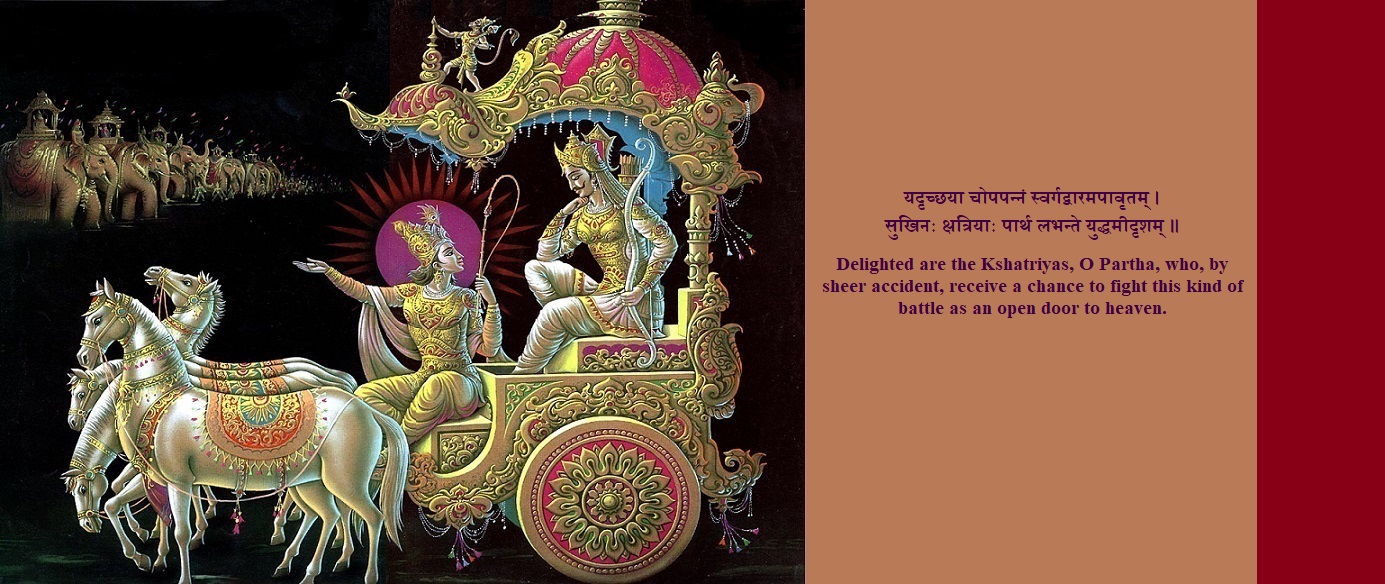
Should we examine Hawking’s concerns, we will find a striking similarity between the distress he went through and that of Arjuna before Kṛshna gave him the instructions of the Bhagavad Gita. As with Arjuna, distress put the philosophically relevant questions in Hawking’s mind too: (1) If the universe has no beginning nor end, what is the place then for a Creator? (2) How can I know the mind of God? Those are indeed brilliant questions for any true seeker of Reality to ask. In the Bhagavad Gita, Kṛshna does deal with those last questions Hawking raised.
The limitations of modern science to reach the final theory of the universe and God (This is a set of quotes arranged in sequence from The Tao of Physics): Let us examine the key limitations of modern science.
“Rational knowledge is derived from the experience we have with objects and events in our everyday environment.”
“Abstraction (or approximation) is a crucial feature of this knowledge because to compare and classify the immense variety of shapes, structures, and phenomena around us we cannot take all their features into account, but have to select a few significant ones. Thus, we construct an intellectual map of reality in which things are reduced to their general outlines.” [It is significant to note here that scientists always consider only a map of the reality, not reality itself.]
“The natural world, on the other hand, is one of infinite varieties and complexities, a multidimensional world which contains no straight lines or completely regular shapes, where things do not happen in sequences, but all together (simultaneously); a world where‒as modern physics tells us‒even empty space is curved. It is clear that our abstract system of conceptual thinking can never describe or understand this reality (behind the universe) completely.” [In the last sentence, the physicist acknowledges that modern science, with its rational methods, cannot discover the truth about the universe.]
“The realm of rational knowledge is, of course, the realm of science which measures and quantifies, classifies and analyses. The limitations of any knowledge obtained by these methods have become increasingly apparent in modern science and in particular in modern physics….”
“The scientific method of abstraction is very efficient and powerful, but we have to pay a price for it. As we define our system of concepts more precisely, as we streamline it and make the connections more and more rigorous, it becomes increasingly detached from the real world.”
“Because our representation of reality (the abstraction or the map) is so much easier to grasp than reality itself, we tend to confuse the two and to take our concepts and symbols for reality.” [Conceptual knowledge thus acquired is relative, not absolute.]
“What Eastern mystics are concerned with is a direct experience of reality which transcends not only intellectual (rational) thinking but also sensory perception.”
“The Eastern mystics repeatedly insist on the fact that the ultimate reality can never be an object of reasoning or of demonstrable knowledge.”
“Absolute knowledge (as against the conceptual knowledge which is relative) is thus an entirely non-intellectual experience of reality (hinting that it is an intuitive experience or awareness), an experience arising in a non-ordinary state of consciousness which may be called a ‘meditative’ or mystical state.” [The physicist emphatically concludes the superior nature of absolute knowledge. In the Vedanta system of India, this mystical state is called turīya, the fourth state, and the other three being the waking, the dreaming, and the deep-sleep states.]
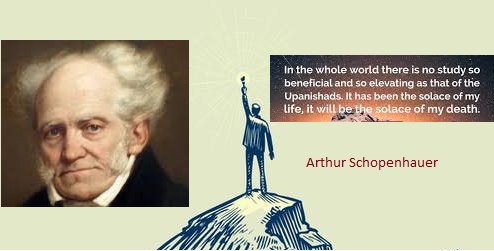
Before we conclude the discussion, let us review the views of a few best brains of modern science on Vedanta or the Upanishadic wisdom. They seem to have derived inspiration from the Indian philosophy. Some of them believed their discoveries were the reinventions of the wisdom of the ṛshis.
Erwin Schrödinger: The Austrian physicist who won Nobel Prize for Physics in 1933 is known for his groundbreaking discoveries in quantum mechanics. The Schrödinger wave equation is fundamental to the wave theory in quantum mechanics. The “imaginary” experiment of Schrödinger’s cat has been popular in teaching the principles of quantum mechanics.
In his book “What is Life?” he writes:
-
My body functions as a pure mechanism according to the Laws of Nature.
-
Yet I know by incontrovertible direct experience that I am directing all motions, of which I foresee the effects that may be fateful and all-important in which case I feel and take full responsibility for them.
-
The only possible inference from these two facts is, I think that I (I in the widest meaning of the word, that is to say, every conscious mind that has ever said “I”) am the person, if any, who controls the motion of the atoms according to the Laws of Nature. [Erwin Schrödinger, What is Life? Cambridge University Press]
Conspicuous is the similarity between these words of Schrödinger and a verse from the Bhagavad Gita (Chapter 18, verse 61):
The one who controls everything lives in the heart region of all beings. That all-controller, by the power of his māyā (principle of appearance), makes all beings (feel that they) revolve as if mounted on a machine. [Observation of Nataraja Guru recorded in his book The Unitive Philosophy.]
A few other quotes of Schrödinger’s:
“This life of yours which you are living is not merely a piece of this entire existence, but in a certain sense the whole; only this whole is not so constituted that it can be surveyed in one single glance. This, as we know, is what the Brahmins (he refers not to a caste but, in the original sense, to the Self-realized ṛshis of India) express in that sacred, mystic formula which is yet really so simple and so clear; tat tvamasi, that is you. Or, again, in such words as “I am in the east and the west, I am above and below, I am this entire world.” [Erwin Schrödinger, My View of the World, Cambridge University Press]
“The multiplicity is only apparent. This is the doctrine of the Upanishads. And not of the Upanishads only. The mystical experience of the union with God regularly leads to this view, unless strong prejudices stand in the West.” [Erwin Schrödinger, What is Life? Cambridge University Press]
“From the early great Upanishads, the recognition (of) Atman = Brahman (the personal self equals the omnipresent, all-comprehending eternal self) was in Indian thought considered, far from being blasphemous, to represent the quintessence of deepest insight into the happenings of the world. The striving of all the scholars of Vedanta was, after having learned to pronounce with their lips, really to assimilate in their minds this grandest of all thoughts.” [Erwin Schrödinger, from an essay on determinism and free will]
“There is no kind of framework within which we can find consciousness in the plural; this is simply something we construct because of the temporal plurality of individuals, but it is a false construction… The only solution to this conflict, insofar as any is available to us at all, lies in the ancient wisdom of the Upanishads.” [Erwin Schrödinger, My Life, My World View, 1961]
Werner Heisenberg: This German Nobel laureate is another brilliant scientist who made spectacular contributions to quantum physics. Heisenberg’s Uncertainty Principle is the quantum mechanics theory he is famous for.
In Uncommon Wisdom: Conversations With Remarkable People (1988), Fritjof Capra writes about Heisenberg’s meeting with the Indian mystic poet and Nobel winner, Rabindranath Tagore: “He (Heisenberg) began to see that the recognition of relativity, interconnectedness, and impermanence as fundamental aspects of physical reality, which had been so difficult for himself and his fellow physicists, was the very basis of Indian spiritual traditions.”
A few other pertinent quotes from Heisenberg:
The finest brains of modern physics too thus suggest that the treasured wisdom sought by humans ever should be found in the teachings of the ancient ṛshis.
(The next article, A Call to Save the World!, brings the discussion to a logical conclusion.)
[ To visit the Bhagavad Gita Self-Study page, click/tap on this link: Bhagavad Gita Svādhyāya]
Leave a comment