
The Bhagavad Gita, Chapter 1, Verses 37 ... 43
[Arjuna’s last remark, “After killing the sons of Dhṛtarāshṭra, what happiness will we have, O Janārdana (Kṛshṇa)? Only sin will come upon us if we kill these ruthless sinners.” He continues.]
Translation
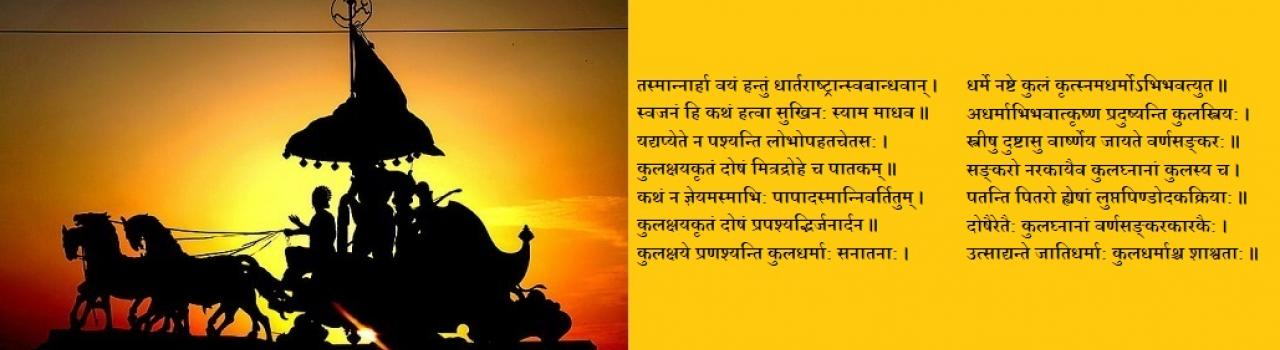
Therefore, it is not right for us to kill the sons of Dhṛtarāshṭra, our relations. O Mādhava (Kṛshṇa), how can we ever remain happy after killing our own men?
Annotation
In verse 34, Arjuna has distinguished his relatives as sambandhinaḥ from the multi-million army men whom he refers to as his own people (svajanaḥ). In the previous verse (verse 36), he has described the sons of Dhṛtarāshṭra, the relatives, as ruthless criminals (ātatāyinaḥ). Now he says it is not right to kill them even though they are the worst of criminals. If we go exactly by the poet’s words, we should read, “we do not deserve to kill (not have the right to kill) the sons of Dhṛtarāshṭra…” Moreover, he uses the inclusive ‘we’ to denote that human beings have no right to kill. This is an assertion that the Bhagavad Gita (Brahma-vidya or Vedanta) does not support killing under any circumstances. Arjuna gets this intuitive awareness only because he is in a transcendental state. Along with this newfound awareness, he believes he will become a sinner by killing even the most contemptible criminals, and he does not deserve it.
This is Arjuna’s argument: the Kauravas, the hated criminals, are also ‘our own people’ because in the vision of svajanaḥ he cannot discriminate them from the rest of the two armies; “and after slaying anybody whom we see as part of svajanaḥ, how can we be happy?” Arjuna’s vision of svajanaḥ is his integral vision of humanity itself. As noted, the usage of the inclusive ‘we’ is to say that the principle of non-killing is universal.
Thus in the present mood, Arjuna brackets the relatives, although criminals, together with the total humanity who deserve to be treated only based on ahimsa (the principle of non-killing). Let us now recognize that Arjuna desists from killing the Kauravas standing on the enemy side, not because they are his relatives. In his vision of svajanaḥ, killing has no place, and he does not see anybody as an enemy either.
Putting Arjuna in a fleeting samādhi, Sage Vyāsa gives the world a foretaste of the yogic experience of a knower of Brahman (Brahma-jñāni).
Translation
O Janārdana (Kṛshṇa) , even if these people, of minds overpowered by greed, see no damage in the destruction of family or no crime in treachery to friends, why should not we learn to be free from these sins because we do see the damage in the destruction of family?
Annotation
Arjuna knows the Kauravas are avaricious and so they have become savage criminals. He argues, “These greedy men neither understand nor worry about the damage occurs when they indulge in unrighteous and criminal activities that lead to a war. The scale of the devastation caused by a war like this will destroy countless families. But, Kṛshṇa, we are sensible to understand that destroying family traditions is a sin because it will cause serious damage to the society. Why should we follow in the footsteps of these ignorant criminals and become sinners ourselves?”
We may think Arjuna’s thoughts drift from the universal perspective he has had in his mystic vision. One may suspect his vision becomes narrow to focus on a family-centric problem, because he seems to worry about the destruction of family. But we should note he is not speaking about a particular family. The annihilation of millions of men in the war is going to ruin the family system that exists as a healthy institution in the society. The carnage will terribly affect the ratio of men to women as well.
Now, if we consider the ruin of Arjuna’s Kuru family, we recognize the serious political and social repercussions as well. The Kingdom needs rulers of right conduct to follow Kshatriya Dharma and ensure the well-being of the world. In his present state, Arjuna cannot accept any kind of destruction that unsettles human life.
Translation
In the destruction of family, the immemorial family morals are lost; on loss of morals, evil afflicts the entire family system.
When evil plagues a family, O Kṛshṇa, women in the family become corrupt; when women are immoral, O Vārshneya (Kṛshṇa), mixing of castes occurs.
Annotation
In the relative world, the family concept and protecting family morals are important, as Arjuna points out. But he singles out the loss of family morals as the prime concern; he speaks as though those morals were the central tenets of dharma. We can thus infer he has only limited knowledge in the realm of dharma, and not conversant with the principle of dharma the Gita teaches. Total neglect of dharma is the reason for the Mahābhārata war. Dharma has already disappeared from the world because the world has lost Yoga Śastra and the yogic way of life. Arjuna is oblivious to this, which Kṛshṇa teaches him later. However, in the strangely awakened state at present, he wants to ensure good things alone for the world; and he is about to rationalize his arguments based on his knowledge of traditional family morals, which he considers dharma.
In the beginning, the four-fold varṇa system (chātur-varṇya), which we have touched upon elsewhere, was in place to identify people based on their naturally suited vocation. Later, at the time of the Mahābhārata, it was already a caste system with its associated evils and rigidities.
Arjuna’s apprehension is that the war caused by a few villains will ruin the family system; moral corruption will be rampant and women in the families will become immoral; if the women bear children of men from other castes, the ‘purity of castes’ can no more be preserved. These are his beliefs influenced by a society that has lost its awareness of genuine dharma.
Translation
When castes are mixed, both the family and the destroyers of the family will live in hell for sure because they cause the fall of their ancestors by depriving them of the offerings of rice-balls and water rites.
Annotation
The descendants of the deceased in a family make offerings of rice-balls and water rites to their ancestors, at least once a year, as a tradition. This is to ensure the continued stay of the ancestors in heaven. As already mentioned, the philosophy of the Gita does not support heaven in the usual sense and so these rites and offerings are superfluous as far as the Gita is concerned.
Arjuna reveals his belief that the mixing of the castes makes the progeny in the family impure; and the rites and offerings made by such impure descendants are not acceptable to the ancestors in heaven. They will thus stay without the offerings of rice-balls and water rites and eventually fall from heaven to hell. Causing the downfall of the ancestors in heaven is a sin and those sinners deserve only to live in hell, Arjuna believes.
Translation
By these wrongs, of the destroyers of the family, causing the mixing of castes, the long-standing laws of castes and family morals are destroyed.
Annotation
Once again, we see Arjuna struggling to express why the war should be avoided at any cost and save all ‘his four million people’ (svajanaḥ). His knowledge of dharma is so limited to the family morals and traditions that he goes deep into what damage will the war inflict on the social set up. He is right about the destruction of the society a war will cause; but he worries he and all the destroyers of family traditions will become sinners and unfit to live in heaven. His present perception is that the highest thing a human being can achieve is going to heaven (hereafter) ̶ a place known for no physical suffering but pleasures or sense gratification alone. We find later that, in reality, he is not able to decide what the best thing is.
-----------------
(To read the next post [Gita Post #12] click/tap on this link: https://www.ekatma.org/node/190)

Comments (2)
Appreciate the simplicity with which these shlokas are translated and annotated, so that we all can understand and appreciate the same.
Thank you very much. Namaste!
Leave a comment