
The Bhagavad Gita, Chapter 1, Verses 44 ... 47
[Arjuna has said in the previous verse, “By these wrongs, of the destroyers of the family, causing the mixing of castes, the long-standing laws of castes and family morals are destroyed.” He continues.]
Translation
The people of a family that has abandoned its traditions (laws), O Janārdana (Kṛshṇa), are destined to live in hell, thus have we heard.
Annotation
Arjuna, despite his experience of the passing mystic state, upholds the practices and notions he has understood to be of high value ̶ speaks of hell, heaven, sins (pāpa), merits (puṇya), the life hereafter, etc. He seems mindful of the do’s and don’ts that help accumulate no sins but merits alone in order to ensure he goes to heaven.
This verse discloses to us what Arjuna’s beliefs mean! When he says, ‘thus have we heard’, he exposes his ignorance of dharma proper. His theories and arguments about family traditions, sins and merits, heaven and hell are not the knowledge he gained from the śāstras (valid philosophical texts). He gathered them from mere hearsays and the loose concepts exist in the family and society with no backing of spiritual or philosophical teachings. As we have already touched upon elsewhere, the author of the Bhagavad Gita had a serious concern that the world lost the wisdom of Yoga in the era of the Mahābhārata; the world followed unscientific ways of life that put humanity in grave peril. The war is right here to destroy the world. Through Arjuna’s theories and arguments, based on hearsays, the poet illustrates the poor state of wisdom in the world, systematically setting the stage for wisdom teaching in the Bhagavad Gita.
Unperturbed, Kṛshṇa, the charioteer, listens in absolute silence. Let us find out what Arjuna’s next grievance is.
Translation
Alas, how unfortunate it is! Being greedy for the pleasures of the kingdom, we are here determined to commit grave sin, for our intent was to kill our own people.
Annotation
Until the earlier verse, Arjuna has spoken about the destruction of family traditions and morals caused by war and the consequences. And here he again insists on saving millions of lives of ‘his own people’ (svajanaḥ). So we now know what has motivated him to argue against destroying family traditions and morals—primarily a reason to avoid the massacre.
In verse 33 he has said, “all the people, for whose sake we have desired the kingdom, enjoyments, and well-being, are standing here…” which means, influenced by the Transcendental (para), he is at present free from every selfish interest of his own. In the present verse, he deeply regrets the unwise decision to go for a war—a decision taken well before his fleeting mystic state. He wails: O Kṛshṇa, I am seeing here and everywhere only our own people. Have we come here to murder them, just for the sake of enjoying the wealth and pleasures of the Kingdom? I cannot believe we are so greedy; no, we are sinners! Don’t you agree the very plan to kill all these people of ours is a heinous sin?
Even when in distress, Arjuna shows he can discriminate between the unwise decision and the ideal judgment. Is he suffering from any serious mental disorder? No, it is only a fun game (līla) of para.
Translation
It will be a blessing for me if the sons of Dhṛtarāshṭra, with weapons in hand, should kill me while I stay unarmed and unresisting in the battle.
Annotation
It is obvious from Arjuna’s statement in verse 45 that he considers a blessing even the late realization of the sin involved in killing his own fellow men (svajanaḥ). Now, he goes still further to the extent of self-sacrifice. Rather than committing the murder of svajanaḥ, he thinks it is preferable to face the Kauravas unarmed and unresisting, and accept death.
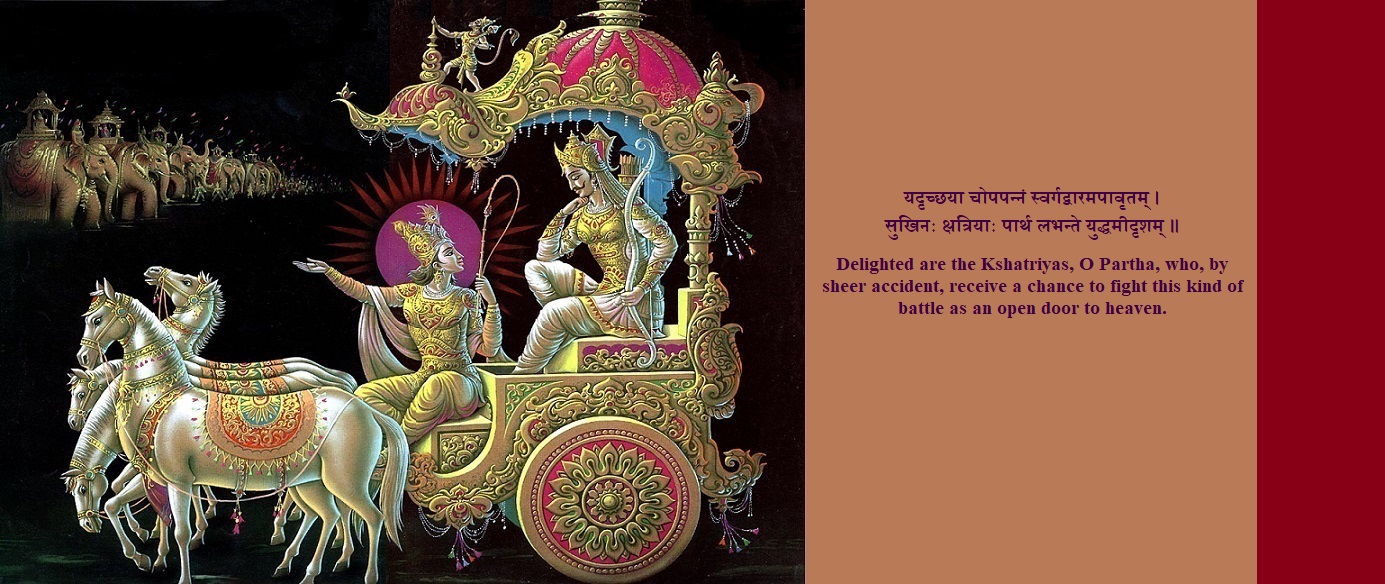
Victory in the battle, if he chooses, is certainly Arjuna’s. He has a weapon which can destroy the entire humanity in half a second ̶ the Pāśupata gifted by Lord Śiva. It is a fact that a person of his temperament will not use such weapons. Our interest is to understand the person holding a destructive power of that magnitude offers to sacrifice his own life. We witness one of the rarest of the rare occurrences, which happens under the influence of para (Brahman) alone. Arjuna wants to save the lives of the entire soldiers on both the armies, including the most dangerous criminals standing on the enemy side. The added advantage he sees is he will save himself from committing sin and go to heaven. He goes by the popular belief that a Kshatriya who dies fighting a righteous battle will go to heaven; so he considers the chance to be killed by the Kauravas a blessing.
Sage Vyāsa thus illustrates Arjuna’s struggle as he goes through an unforeseen experience of a fleeting samādhi. Because he is unaware of what he undergoes, the event is more intriguing to the onlookers.
Translation
Sañjaya said: Having spoken these words amidst the ongoing battle, Arjuna has tossed aside his bow and arrow and sat down in his chariot seat, his mind overwhelmed with grief.
Annotation
In his present state, influenced by the Transcendental, Arjuna realizes himsa (killing or hurting) of any kind, being greedy (being a slave of kāma) and discriminating people on any grounds are not correct. He has a faint hint of a ‘higher life’ that all human beings must aim at and strive, at any cost, to attain; no greater value he sees in anything else. Based on what he has understood as dharma in the relative world, he suspects the higher life to be the life in heaven. Driven by this awareness, he has offered to sacrifice his life. The distress he goes through is indeed the spiritual tension one experiences in such a dilemma ̶ on one side, the pivotal role expected of him in leading the Pāṇḍava army to victory and on the other, an uncontrollable urge to abide by the rare vision of Truth that flashed through his mind.
Arjuna's mind is overwhelmed with grief (śoka samvigna mānasaḥ). Nothing but the presentiment of a disaster for humanity has made him utterly desolate. In the domain of para, the supreme concern one feels is for the welfare of the world.
Not being on a sound philosophical footing, Arjuna grapples with an irreconcilable internal conflict and the resulting confusion. A passing (kshudra) samādhi may give a glimpse of the Reality but not the wisdom (jñāna) that establishes one in a firm, lasting yogic state (being yoga yukta). If there is a way to gain the missing wisdom on the spot and he can perfectly absorb the same within the brief span of his passing samādhi, chances are high that he becomes a yogi or a knower of Brahman (brahma-jñāni). Then he becomes a genuine Kshatriya, thus says Sage Vyāsa.
What is the purpose of Chapter 1 of the Bhagavad Gita?
When we read the Bhagavad Gita as the irrefutable, final philosophy the Mahābhārata presents, we understand it better; many Gita statements that sound ambivalent reveal their true meaning. This chapter marks the transition to the philosophy in pure form from the exhaustive analysis of the socio-political scenarios in a world where the wisdom of Yoga Śāstra is missing, dharma has disappeared. In a world of adharma, the Sage has to present the perennial philosophy with suitable revaluation — in a language and terminology acceptable in a world of adharma (unrighteousness)! When doing so, superficially, the philosophy may appear to be providing for justice in the relative world and such justice will seem to be dharma. The Mahābhārata war may look justified and righteous (dhārmic). But the contemplative, who studies the Gita as a text of Brahma-vidya, draws a different meaning. Nataraja Guru declares in his scholarly commentary on the Bhagavad Gita, “Relativist forms of war between closed or static groups, whether clans, tribes or races or even nations or religions, are not ‘righteous’ according to the Gita teaching which takes humanity’s welfare only into the scope of the word dharma (righteousness).” [The Bhagavad Gita by Nataraja Guru ̶ 1989 edition by Narayana Gurukula Foundation]
Before the Guru starts instructing the disciple in Yoga Śāstra, the author should bring out the anterior views (pūrva pakshin) prevailing in the world as against the philosophy of the Bhagavad Gita. Arjuna’s expressions of his confused notions of dharma represent the anterior views; and the need to enlighten the world of dharma is thus demonstrated. In the normal temperament of Arjuna, Vyāsa could not expect Arjuna to present those anterior concepts and beliefs as he does in Chapter 1. So the Sage puts him on a passing samādhi, which is well justified in the presence of Śri Kṛshṇa, the Absolute.
Arjuna's presentation of the anterior notions is just the final signal, whereas the entire Mahābhārata story that illustrates the total neglect of dharma in the world has already prepared the ground for the Gita teaching.
Although the subject of the Bhagavad Gita is what the Upanishads teach, the presentation style it has adopted is uniquely dramatic, with tremendous potential to attract the attention of even those who are less inclined to pursue Brahma-vidya. But then accurate interpretations that reveal the wisdom the Sage has intended for the welfare of the world are equally important.
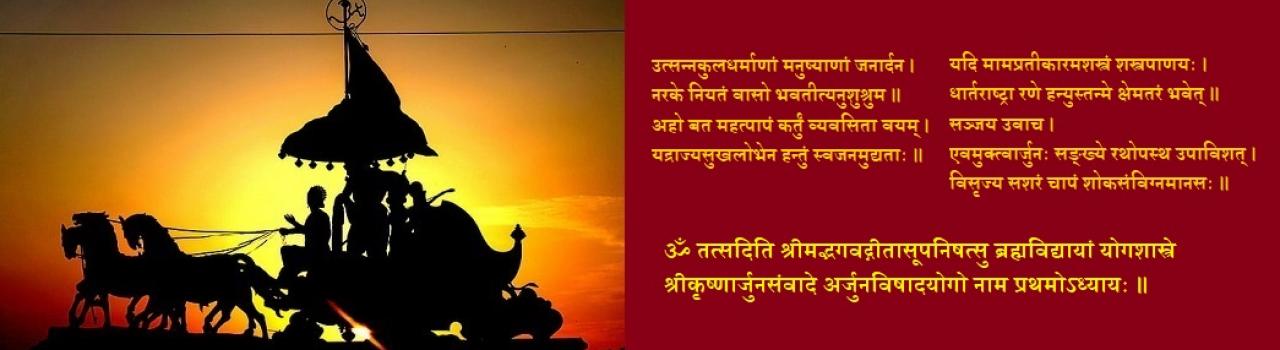
Aum tatsaditi srīmad bhagvad gītāsūpanishatsu brahma vidyāyām yoga śāstre Srī Kṛshṇārjuna samvāde Arjuna vishāda yogo nāma prathamodhyāyaḥ.
(ॐ तत्सदिति श्रीमद्भगवद्गीतासूपनिषत्सु ब्रह्मविद्यायां योगशास्त्रे
श्रीकृष्णार्जुनसंवादे अर्जुनविषादयोगो नाम प्रथमोऽध्यायः ॥)
Thus ends Chapter One entitled Arjuna-Vishāda Yoga in the Upanishads of the Bhagavad Gita, in the Science of Brahman (the Absolute), in the Science of Yoga, in the dialogue between Sri Kṛshṇa and Arjuna.
A note on Kshudra Samādhi (Passing Mystic State)
It is easy to recognize that an abrupt experience of a mystic state occurred to Arjuna has thrown him out of balance. We have read Vyāsa’s words in this Chapter, which directly support this explanation. [In verse 28 we read, kṛpayā parayā āvishṭaḥ, which means “filled with the concomitant compassion when seized by para, the Transcendental (Brahman)!”] The apparent impulsive change in behavior, upholding the supreme principle of ahimsa, influenced by the all-powerful para, is more logical; but is the story of kshudra samādhi a plausible one? In our study, a definitive understanding is far better than being confused with the inconclusive speculations about Arjuna’s state of mind. The Sage has chosen an ever-incomparable canvas that integrates a variety of literary devices and the mythical language to create a graphic illustration of the Science of Brahman. There, a passing mystic state of Arjuna needs no separate explanation. We will include a brief comparative study of Arjuna’s mystic experience at a more appropriate stage of our study. Here we present a couple of interesting mystic experiences recorded in recent times:
Example-1
An Oxford graduate from London, Arthur Osborne, reached the ashram of the twentieth-century mystic, Ramana Maharshi, who lived in the realm of the Absolute. After a few weeks of his arrival at the Tiruvannamalai ashram in South India, he was thoroughly disappointed because he did not find the Guru he dreamed of in Ramana Maharshi. After a few days, as Osborne wrote, “Bhagavan (Ramana Maharshi) was reclining on his couch and I was sitting in the front row before it. He sat up, facing me, and his narrowed eyes pierced into me, penetrating, intimate, with an intensity I cannot describe. It was as though they said: ‘You have been told; why have you not realized?’ And then quietness, a depth of peace, an indescribable lightness and happiness…. My love and devotion to Bhagavan deepened. I went about with a lilt of happiness in my heart, feeling the blessing and mystery of a Guru, repeating like a song of love that he was the Guru, the link between heaven and earth, between God and me, between the Formless Being and my heart. I became aware of the enormous grace of his presence….” [Page 28, Be Still, It Is The Wind That Sings by Arthur Osborne]
We see an example of a transient mystic experience, although not comparable with that of Arjuna. At the beginning of Chapter 1, we introduced a term pārasparya (bipolarity), the guru-disciple relationship. A devoted disciple receives the grace of the guru as a profound psychological influence through pārasparya. A wise guru who has transcended the relative world and living in the realm of the Absolute has the yogic power to identify genuine disciples and guide them through pārasparya. Ramana Maharshi’s graceful presence brought about the foregoing experience of Osborne. Let us not forget that Arjuna enjoyed the affection and proximity of the All-powerful!
If a piece of iron is brought near a magnet, the iron piece will also show magnetic properties. Physical science explains this phenomenon, but we know it is a phenomenon of Nature. We humans rarely realize we are part of the same Nature. There are many phenomena of Nature ‘inherited’ by humans as well, but modern science would not have had chances to record them as scientific observations. The experience of Arjuna in front of Kṛshṇa or that of Osborne before Ramana Maharshi may be seen as a phenomenon parallel to the one of the magnet and the iron piece. Not all metals brought to the magnet show magnetic properties. In the same way, there should be Nature’s rules that apply among humans too. Therefore, such experiences are not everyday occurrences to everybody.
Example-2
The influence of para need not always be on account of the Absolute present in another body; the same Consciousness within one could give curious experiences to oneself.
Fritjof Capra writes in his preface to the Tao of Physics, ‘I was sitting by the ocean one late summer afternoon, watching the waves rolling in and feeling the rhythm of my breathing, when I suddenly became aware of my whole environment as being engaged in a gigantic cosmic dance. Being a physicist, I knew that the sand, rocks, water, and air around me were made of vibrating molecules and atoms, and that these consisted of particles which interacted with one another by creating and destroying other particles. I knew also that the earth’s atmosphere was continually bombarded by showers of “cosmic rays,” particles of high energy undergoing multiple collisions as they penetrated the air. All this was familiar to me from my research in high-energy physics, but until that moment I had only experienced it through graphs, diagrams and mathematical theories.
‘As I sat on that beach my former experiences came to life; I “saw” cascades of energy coming down from outer space, in which particles were created and destroyed in rhythmic pulses; I “saw” the atoms of the elements and those of my body participating in this cosmic dance of energy; I felt its rhythm and I “heard” its sound, and at that moment I knew that this was the Dance of Shiva, the Lord of Dancers worshipped by the Hindus.’
That was another real-life experience, a transitory one, of a dedicated researcher in high-energy physics. Unless influenced by para (which is the same as the Consciousness within), one cannot experience atoms dancing around oneself!
Capra adds, ‘In the beginning, I was helped on my way by ‘power plants’ which showed me how the mind can flow freely; how spiritual insights come on their own, without any effort, emerging from the depth of consciousness.’
-----------------
(To read the next post [Gita Post #13] click/tap on this link: https://www.ekatma.org/node/192)
Comments (5)
Very interesting and refreshing to read a new way of explanation. It is needed today. Very inspiring. Thanks.
Thank you. Namaste!
The best explanation I read.
Namaste!
Received the following question by email; many readers may have the same question in their minds. Therefore, an answer to this question is also given at the bottom:
Question:
With reference to the following (in this blog).....
When he says, ‘thus have we heard’, he exposes his ignorance of dharma proper. His theories and arguments about family traditions, sins and merits, heaven and hell are not the knowledge he gained from the śāstras (valid philosophical texts). He gathered them from mere hearsays and the loose concepts exist in the family and society with no backing of spiritual or philosophical teachings.
One question....how is it that Arjuna, after all his interactions with various rishis and gurus in his previous years, is deemed ignorant of `dharma proper'?? He is not some ordinary man who has been completely deprived of education into dharma and its concepts. Unless, collectively all the gurus and rishis failed him!
Answer:
A detailed answer was already part of a blog to be posted soon ̶ an explanation not available so far in print! However, that answer is a broader one, covering why Arjuna was chosen as the disciple in the Bhagavad Gita. With reference to the present question, here are some specific points to ponder:
1. Among all the kings and princes of that time, Arjuna was the most brilliant one in archery. He and his brothers were good human beings and definitely were righteous in a world that had become corrupt and immoral. But here when we say dharma proper, it is not in the sense of what we call righteousness in the relative world. It is about the principle of Brahman. In the domain of Brahman, dharma means the system (with its own laws) that keeps the Cosmos in order. Human beings who seek Truth (which is the ideal goal) have to follow the 'way of life', according to those 'laws', that leads to Brahman-realization (which is also called Self-realization or in religious parlance God-realization). Perfect harmony with the cosmic system is the goal. It is very obvious that Arjuna never mentioned about that as the highest goal in life; instead, he only knows of a heaven which is the abode of sense-gratifying pleasures alone! And per that notion of heaven, life in heaven comes to an end when the accrued merits (puṇya) are exhausted; then the person has to be born again on earth and the cycles of suffering will continue. That heaven does not lead to Liberation or Immortality. The Upanishads and the Gita do not teach about that heaven. So, Kṛshṇa is about to teach Arjuna what the highest goal of a human being should be.
2. Then there is a secret that is not yet brought out by any published Gita commentary. According to the philosophy Vyāsa teaches through the Bhagavad Gita and the entire Mahabharata, the most essential quality of a Kshatriya is to become a knower of Brahman, to become Self-realized! Instead, all commentaries tell Arjuna is a Kshatriya and a Kshatriya is a (mere) warrior. We will present, as appropriate, Vyāsa’s own views from the vast epic poem and will quote them to explain what the poet really means... All these will be made clear over the next several blogs, citing Vyāsa’s own words as evidence. So, the point is Arjuna who was supposed to be Self-realized according to the original definition of a Kshatriya did not even express any 'bookish' or ‘academic’ knowledge of Brahman and dharma at the highest level. A Kshatriya's real dharma is not fighting wars though that became the common belief in later times. At the time of Arjuna, Kshatriyas were ignorant of their dharma (even in the sense of their duty). We will be covering what the Sage means by Kshatriya Dharma.
3. Who were the gurus of Arjuna (and the entire Kuru family)? Drona and Kṛpa. And Bhishma, the grandsire, was also termed a guru by Arjuna himself in the second chapter of the Gita. Kṛpa and Drona were teachers of Dhanur-veda (the science of archery and warfare); the focus of these teachers was never on Veda and Vedanta (the subject matter of the Bhagavad Gita is pure Vedanta, i.e.: the teachings of the Upanishads: https://www.ekatma.org/node/175). Bhishma himself was a mighty warrior, though he was scholarly as well. But they were all on the side of adharma. In the relative world, they could not stand by the standard dharma (righteousness) of the world; then how could they be the teachers of dharma proper! In the summary of the Mahābhārata, Gita Post # 2, it was brought out in the episode of the dice game:
"Following Duryodhana’s order, his brother Duśśahsana dragged Draupadi into the large dice game hall, insulted and attempted to disrobe her before the entire spectators including all the Kuru elders such as Bhīshma, Droṇā, et al. Bhīshma had an image in the Kuru family and even among the citizens that he was an authority on dharma. The urge to restore dharma at those moments of absolute depravity did not occur to the old Kuru hero either." (Link: https://www.ekatma.org/node/163)
None of the Kauravas or Pāṇḍavas were taught by a true ṛshi.
4. In the first part of the summary of the Mahābhārata, Gita Post # 1, we highlighted the following important reason behind the teaching of the Bhagavad Gita:
The Thrust to Restate the Upanishadic Wisdom
What prompted Vyāsa to restate the Upanishadic wisdom through a work of art such as the Mahābhārata? He must have been the witness to a time in the history of ancient India when the age-old righteous way of ruling the nation disappeared altogether. In the Upanishadic period, kings had the dharma born of Brahman as the basis for governance. The evidence is in the Bhagavad Gita itself. Vyāsa says through Kṛshṇa, “Arjuna, the Yoga (the wisdom of yoga śastra) I am teaching you is the Yoga that has always existed. Your ancient ancestors who were rājarshis (king-sages) transmitted without fail the same yoga śastra from generation to generation. Alas, that yoga (and its influence in the world) has been lost for a long period now!” [The Bhagavad Gita IV.1 & IV.2.] Kṛshṇa cites the disappearance of the yogic way of life as the reason for the moral degeneracy (adharma) in the world. To save the world, the author of the Mahābhārata intends to restore yoga śastra or Brahma-vidya." (Link: https://www.ekatma.org/node/157)
The foregoing is Vyāsa 's declaration that the ruling class (Kshatriyas) of Arjuna's time did not know dharma proper!! Dharma proper is understood only by learning yoga śastra and becoming a Self-realized yogi. Vyāsa reiterates in the epic that knowledge of Brahman (brahma-jñana) is the primary 'qualification' of a genuine Kshatriya to be a ruler!
Interestingly, Vyāsa's firm theory is that the world will have perfect peace and happiness only if the rulers are ṛshis (whether the system is democracy or monarchy or whatever)! We touched upon this aspect in the summary of the Mahābhārata, Gita Post # 1. (Link: https://www.ekatma.org/node/157) Details will be covered at appropriate places in our Gita study.
Leave a comment